Virtual Try-On for Workwear and Uniforms: Fixing Bulk Sizing Without Guesswork
Quick answer
Most virtual try-on coverage is written for a single shopper buying one item for themselves. Workwear and uniform ordering is a different problem. A single procurement decision covers dozens or hundreds of people at once, and a bad size guess is not one return, it is a batch of them.
Why is uniform and workwear sizing harder than regular retail?
A uniform order usually starts with a form: pick your size from a chart, submit, wait for delivery. That size is often the one the employee wears in their own casual clothes, not the one that fits a scrub top, a chef's coat, or a hi-vis jacket cut for movement and layering. Workwear brands do not share a common sizing standard with everyday retail, so a self-reported guess is frequently wrong before the order even ships.
There is also less room to correct course than in ordinary online shopping. A single shopper who orders the wrong size online just returns it. A company that orders one hundred sets of scrubs in the wrong size is managing a reissue project, not a return.
What does a bad bulk uniform order actually cost?
Industry coverage of uniform rollouts describes a consistent pattern: skipping a fitting step in favor of ordering straight from a size chart, then discovering sleeves are short or a cut does not match across styles once the shipment arrives. A mid-cycle reorder to fix that tends to cost more per unit than the original order did, since it loses any bulk pricing and adds a second shipping and handling cycle on top of the first.
- Lost work time. An employee who cannot wear a uniform that does not fit properly, particularly where fit affects safety, may be unable to start a shift until a replacement arrives.
- No easy return path. Consumers are used to free returns from ordinary ecommerce, but corporate uniform orders rarely have the same return supply chain, so a wrong-size batch is harder to unwind than a retail order.
- Repeat cost on the same headcount. A reorder covers people who were already paid for once in the original order, so the business absorbs the sizing mistake twice.
How does virtual try-on help HR and procurement teams order workwear?
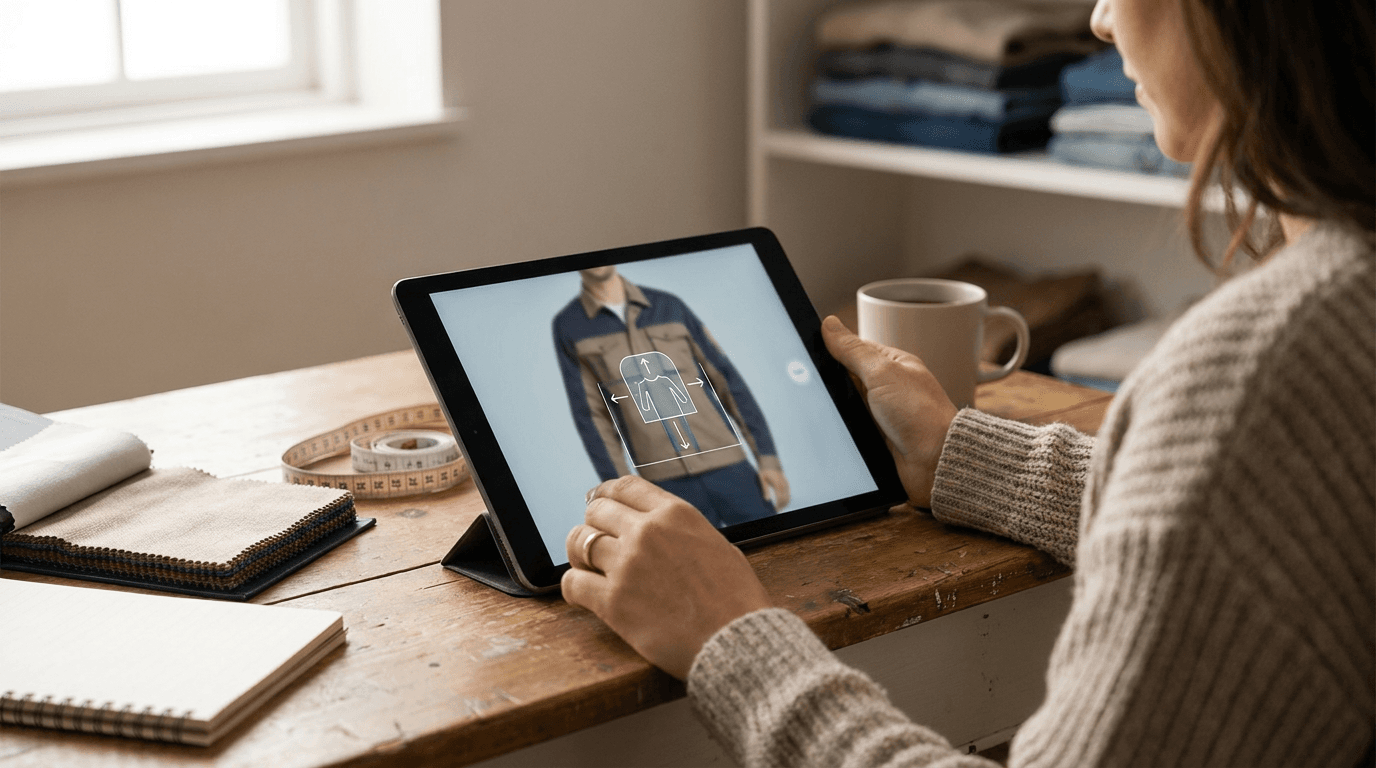
A fit preview moves the sizing question earlier, before the order is placed rather than after the delivery arrives. An employee uploads a photo, picks a size against the actual uniform garment, and sees how it sits on their own body instead of guessing from a chart designed for a generic size run.
That matters most for the categories where fit is hard to judge from a size label: fitted scrub sets, tailored corporate wear, and school uniforms bought by a parent who has not seen the child try the exact garment on. It matters less for loose, one-size-fits-most items like a plain hi-vis vest, where the fit question barely exists in the first place.
What should a workwear supplier look for in a try-on tool?
General fashion virtual try-on and B2B uniform ordering are related but not identical problems. A supplier evaluating a tool for this use case should check a few things beyond general image quality.
- Confirm the tool can render a full outfit, not just a single garment, since most uniforms are a top and bottom worn together.
- Check whether it can be called from a custom B2B ordering portal through an API, not only a standard storefront widget, since many procurement systems are not a typical retail checkout.
- Ask for a plain answer on photo handling before asking an entire workforce to upload a photo. A vague privacy policy is a bigger liability across hundreds of employees than across a handful of retail shoppers.
- Confirm the person's actual body shape is preserved in the result rather than smoothed toward a generic model, since the whole point is judging real fit, not a flattering approximation.
How does Corlen fit into a workwear or uniform supplier's ordering flow?
Corlen renders a person's uploaded photo against a supplier's real garment images, generating a top and bottom together the same way any two-piece outfit works on the platform, in about 10 to 15 seconds. On a Shopify store, this runs directly through Corlen's Shopify app on the product page. A supplier running its own procurement portal or ordering system gets the same generation engine through the developer API instead, the approach covered in more depth in virtual try-on API for developers.
The broader case for why a fit preview cuts returns and reorders in fashion generally is covered in how to reduce online fashion returns. See it on your own photo first: try Corlen for free, no account needed for a first result.
Frequently asked questions
Why does uniform and workwear sizing go wrong so often?
A bulk order usually relies on employees self-reporting a size from memory, but workwear brands cut differently from everyday clothing, and the same person can wear a different size in a scrub top than in a T-shirt. Industry coverage of uniform rollouts points to this mismatch, plus limited sample fittings before a large order, as the main driver of reissues.
Can virtual try-on replace an in-person uniform fitting?
Not entirely for garments where safety fit matters, like protective workwear with exact tolerances. But for everyday uniform items, corporate apparel, and school uniforms, a photo based preview answers the question a size chart cannot: how does this actually look and sit on this specific person, before an order goes out.
Is it safe to ask employees to upload a photo for a uniform order?
Corlen never runs face recognition or biometric analysis on an uploaded photo. On a Shopify store's product page, the photo exists only in memory for the single request that generates the preview, and is never stored. A kiosk photo is deleted automatically within 2 hours, or immediately if the person taps Delete My Photos.
Does this work for a full uniform set, like a top and matching bottom?
Yes. Corlen renders separate garments as layers on the same photo, so a shirt and a pair of trousers, or a scrub top and scrub pants, can be generated together, the same mechanism used for any two-piece outfit on the platform.
How does a workwear supplier add this to an existing store?
On Shopify, Corlen's app installs on the product page directly. A supplier running a custom procurement portal or B2B ordering system can call the same generation engine through the developer API instead of the storefront widget.
Ready to add real try-on to your store?
Install Corlen on Shopify in minutes, or build it into your own platform with the developer API.
Similar posts
Does Virtual Try-On Work for All Skin Tones?
AI virtual try-on can shift skin tone the same way any generative model can. Here is why it happens, what a photo based tool changes, and what to check.
Read articleGuidesDoes Australian Law Require Online Clothing Stores to Accept Returns?
Australian Consumer Law guarantees a refund for faulty clothing, but not for a change of mind. Here is what online stores actually owe shoppers.
Read articleGuidesBuild vs Buy: Should You Build Your Own Virtual Try-On AI?
Weighing an in-house virtual try-on model against an API or app. What building it yourself actually requires, and when that effort is worth it.
Read articleSee it on your own photo
Corlen shows your customers how any garment looks on their own body, in seconds. Try it free, no account needed.
Try Corlen free