Virtual try-on for wedding dresses: why fit confidence matters more here
Quick answer
Most dresses can be ordered, tried on, and sent back if the fit is off. A wedding gown often removes that safety net entirely. That single difference changes what a shopper needs before checkout, and what a bridal or formalwear store should be offering on its product page.
Why is shopping for a wedding dress online different from other clothing?
A bridal purchase carries three problems stacked on top of each other that a t-shirt order does not. The gown is worn once, for an event that cannot be rescheduled around a shipping delay. Bridal designers size their own gowns separately from ready-to-wear, so a shopper's usual size number often does not carry over. And in-person bridal shopping traditionally comes with a stylist in the room helping compare silhouettes on the actual body in front of them, a step that disappears entirely online.
None of those problems are unique to bridal wear on their own. Together, on a single high-stakes purchase, they raise the cost of guessing wrong far above what a returned t-shirt costs a shopper or a store.
Why are most wedding dresses non-returnable once ordered?
Bridal retailers treat returns very differently from the rest of apparel, and the reasons are mostly structural rather than a policy choice made to be unhelpful.
- Made-to-order and custom sizing. A gown cut to a specific bride's measurements has no resale value to another customer, so custom orders are routinely excluded from any return window from the start.
- Alterations start the moment it arrives. Most bridal gowns are bought expecting a tailor's changes, and once cutting or fitting begins, the garment cannot go back to being new stock.
- Sample and try-at-home programs carry their own fees. Even stores that let a bride try dresses at home before buying often charge for the privilege, since each sample can only be shown to so many people before it shows wear.
- A single-use event garment has thin resale demand. Unlike a jacket a store can restock and sell to the next customer, a worn wedding gown is a hard sell even at a discount.
The result is a category where reducing returns before checkout is not just cost-efficient, it is often the only option. A wrong-fit swimsuit can sometimes still be exchanged; a cut and altered wedding gown usually cannot, the same all-or-nothing dynamic covered in virtual try-on for swimwear for a different category with its own final-sale problem.
What does virtual try-on actually change before a bridal purchase?
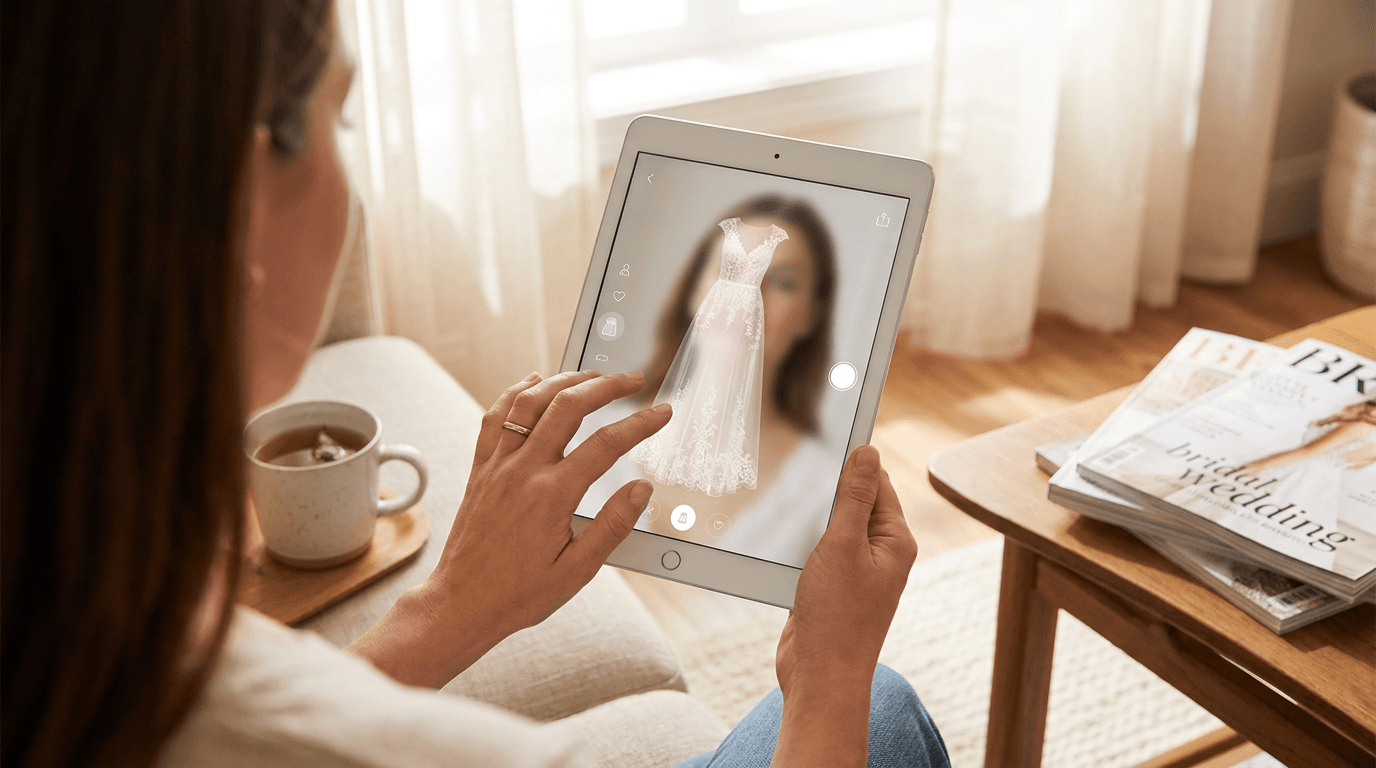
A studio photo of a gown on a professional model answers what the dress looks like on a specific body that is not the shopper's. Virtual try-on renders the same gown against the shopper's own uploaded photo instead, so silhouette, neckline placement, and how the fabric falls at the waist and hem show up before an order is placed rather than after a fitting appointment.
That does not replace a tailor or an in-person fitting, and it should not be sold as if it does. What it replaces is the guesswork of choosing a style from a single catalog photo, then discovering weeks later at a first fitting that the silhouette does not suit the body it was ordered for.
Does this help bridesmaid and wedding party orders too?
Bridesmaid and wedding party orders add a coordination problem on top of the individual fit problem. Several people, frequently in different cities, need to agree on one style that has to work across different body shapes before anyone places an order.
- Each bridesmaid previews the same dress on her own photo. Instead of everyone judging fit from one photo of a single model, each person sees the actual style on her own body shape.
- Disagreements surface before the order, not after. A style that looks wrong on one member of the party is easier to swap out before checkout than after five dresses have already shipped.
- The bride can compare the whole party at once. Seeing how the same dress renders across different builds is a faster way to confirm a style choice than waiting on individual photos sent back one at a time.
How does Corlen fit into a bridal or formalwear store's site?
Corlen generates a result directly against a shopper's uploaded photo and a store's real garment images, locking face, body shape, and background so only the clothing changes between the photo and the result. On a Shopify store, this runs on the product page itself through Corlen's Shopify app, with no separate app or account for the shopper to set up.
A formalwear or bridal retailer building a custom fitting flow, including one that sits alongside an existing appointment booking system, can use the same underlying engine through the developer API instead of the Shopify integration.
See it directly first: try Corlen on your own photo, no account needed for a first result.
Frequently asked questions
Can you really try on a wedding dress online?
Yes, with AI virtual try-on you upload a photo of yourself and the tool generates a new image showing you wearing a specific gown, rendering silhouette, neckline, and how the fabric falls on your own body rather than a model's. It is not the same as a hands-on fitting, but it replaces a flat product photo with something closer to how the dress will actually sit on you.
Why are wedding dresses usually final sale?
Bridal gowns are frequently made to order in a specific size, or are treated as a one-time-use item that a store cannot resell once altered, tried on, or worn. Custom-sized gowns in particular are almost always excluded from standard return windows, which is stricter than how most everyday clothing is sold.
Why does a wedding dress size not match my everyday size?
Bridal designers commonly run their own sizing separate from ready-to-wear, and bridal size charts often size smaller than a shopper's usual number for the same measurements. Ordering by a familiar size instead of the brand's actual bridal chart is one of the more common ways a bridal order goes wrong before alterations even start.
Does virtual try-on work for bridesmaid dresses too?
Yes, and it solves a slightly different problem there: getting several people, often shopping from different locations, to agree on the same style across different bodies before anyone orders. Each bridesmaid can preview the same dress on their own photo instead of guessing from one photo of a single model.
Is it safe to upload a personal photo to try on a wedding dress?
Corlen does not run face recognition on any uploaded photo, and photos are handled on a short retention window rather than kept indefinitely. Our guide on is virtual try-on safe covers the full privacy handling in detail.
Ready to add real try-on to your store?
Install Corlen on Shopify in minutes, or build it into your own platform with the developer API.
Similar posts
Virtual Try-On for Made-to-Measure and Custom Clothing Stores
Made-to-measure stores fix fit with tape measures, not try-on. See where a virtual try-on preview still helps a custom clothing shop, and where it does not.
Read articleGuidesVirtual Try-On for Streetwear Brands: Prints, Drops and Fit
Streetwear sells on graphics, oversized cuts and limited drops. See what a streetwear store should test in virtual try-on before relying on it for a release.
Read articleGuidesVirtual Try-On for Knitwear and Sweaters: What to Test First
Knitwear stretches, drapes and runs oversized, which makes fit hard to judge online. See where virtual try-on helps a sweater store and what to test before you rely on it.
Read articleSee it on your own photo
Corlen shows your customers how any garment looks on their own body, in seconds. Try it free, no account needed.
Try Corlen free