AI Shopping Agents Are Buying Clothes. Fit Data Is the Gap

Quick answer
For most of the past year, AI and shopping meant a chatbot that could describe a product or point you toward a store. That is changing. A handful of retailers have started letting an AI agent take the next step too: pull a shopper's sizing profile, recommend an item, and in some cases place the order. Fashion is one of the first categories this is being tested on, and one of the hardest, because clothing fails in a way a book or a phone charger never does. It arrives and it does not fit.
What is agentic commerce in fashion?
Agentic commerce is a shopping flow where an AI agent acts on a person's behalf instead of the person browsing directly. Stripe and OpenAI co-developed the Agentic Commerce Protocol, an open standard for how an agent talks to a merchant's systems to complete a purchase, and Salesforce has since built support for it too. That protocol handles the plumbing: product discovery, checkout, payment. It says nothing about whether the item the agent picked will actually fit the person it bought it for.
Who is actually building this right now?
- True Fit launched an agentic AI shopping experience in March 2026 for a small group of early retail partners, with a wider release planned for April. It runs on close to two decades of purchase and return data across hundreds of millions of shoppers, and it is built specifically to catch a shopper's 'will this fit?' moment before checkout, not just to recommend a product.
- Bold Metrics released an Agentic Sizing Protocol, an API that lets an AI agent ask a shopper a short set of questions and pull back a size recommendation in real time. Gap is among the first retailers testing it, according to WWD's reporting on the launch.
- Stripe and OpenAI's Agentic Commerce Protocol is the checkout layer underneath deals like these: a shared way for an agent to place and pay for an order once it has decided what to buy. It is a payments standard, not a fit engine, and several separate companies are building the fit layer on top of it.
Why fit is the hard part for a shopping agent
Both True Fit and Bold Metrics solve fit the same general way: collect a few data points from the shopper, match them against a body model or past purchase history, and output a size. That works reasonably well for a return customer with a purchase history on file. It works less well for someone buying a brand they have never worn, where there is no history to match against and the only real signal is the garment's own cut, drape, and how it sits on a body shaped like theirs.
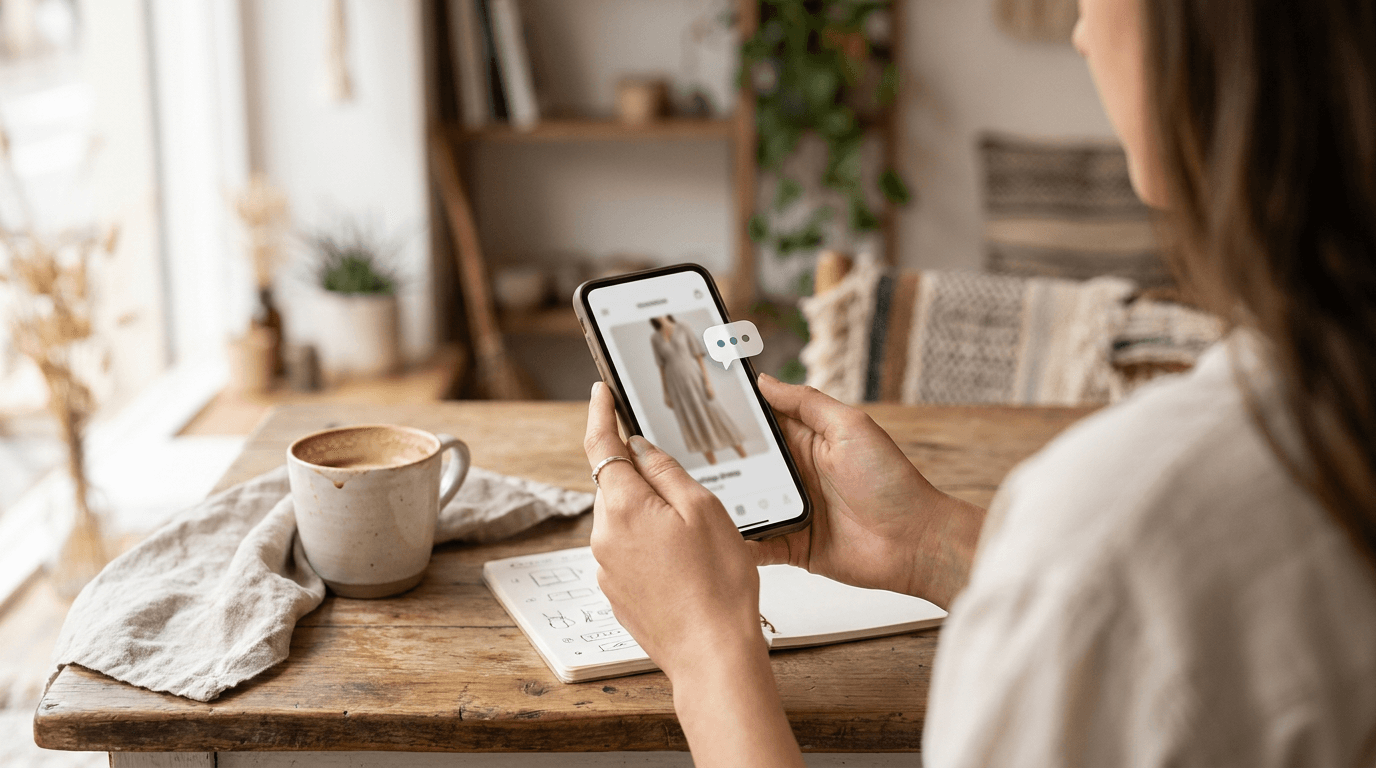
A number does not show a shoulder seam sitting too far past the shoulder, or a hem that will hit mid-thigh instead of the knee. A photo does. That is the gap virtual try-on fills, and it is a gap none of the agentic sizing tools above claim to close. An agent that can recommend a size but cannot show what that size looks like is still asking the shopper to trust a guess, the exact trust problem reduce online fashion returns already covers on the human-shopping side of this.
What this means for your store today
None of this is close to a general standard yet. It is live at a small number of large retailers, coordinated through partnerships most stores are not part of. But the direction is worth noting for two reasons.
- An AI agent, whether it is checking out on Stripe and OpenAI's protocol or just researching a purchase for a person, reads the same product page a human shopper does. A page with an accurate fit preview gives it (and the person reading its summary) a better signal than a size chart alone.
- Sizing data built for a fit-prediction agent and a visual preview built for a shopper are not competing investments. A store that already has both a size guide and virtual try-on on its product pages is closer to being agent-ready than one relying on a size chart by itself, without needing to build anything agent-specific yet.
This is the same ground Corlen already covers, whether the shopper generating a try-on is a person on your Shopify product page or, eventually, an agent acting for them. The kiosk and API versions of the same engine work the same way: a real photo in, a realistic preview out, no fit guesswork in between. See AI shopping search added virtual try-on for the related shift already happening inside Google and Perplexity's own search results, a step ahead of full agentic checkout but built on the same underlying assumption: shoppers, human or AI-assisted, now expect to see the fit before they buy.
Getting started
A developer building against an agent protocol can call Corlen's API directly to add a visual fit check to that flow. A merchant just wants the same groundwork on their own store today: add virtual try-on to your Shopify product pages, or try Corlen on your own photo in a few seconds to see what a shopper, or eventually an agent shopping for one, would actually see.
Frequently asked questions
What is agentic commerce?
Agentic commerce is shopping carried out partly or fully by an AI agent acting on a person's behalf, rather than a person clicking through a site themselves. The agent can search a catalog, compare products, and in some setups complete checkout, using a standard like the Agentic Commerce Protocol that Stripe and OpenAI co-developed and that Salesforce has also adopted.
Can an AI agent actually buy clothes for someone right now?
In limited, early rollouts, yes. True Fit launched an agentic AI shopping experience for select retail partners starting March 2026, and Bold Metrics released an Agentic Sizing Protocol that Gap is testing, letting an agent pull a shopper's fit profile before recommending a size. Neither is a general-purpose feature available on every store yet.
How does an AI shopping agent know if a piece of clothing will fit?
It asks. Bold Metrics' protocol has the agent collect a handful of details (height, weight, a couple of key measurements or fit preferences) through conversation, then match that against a body profile and the garment's own measurements. True Fit does the same using purchase and return history built up over roughly two decades. Neither approach shows the shopper what the garment actually looks like on their own body.
Does virtual try-on work with AI shopping agents?
Not natively yet; these are separate, young technologies solving related problems. But the gap is obvious: a numeric fit prediction can tell a shopper their measurements suggest a medium, while a photo-based try-on shows them exactly how that medium sits on their shoulders. A developer building an agent flow can call Corlen's API as the visual confirmation step before an agent completes a purchase.
Should a small fashion brand worry about this yet?
Not urgently, but it is worth watching. These systems are live at a handful of large retailers (Gap, and True Fit's early-access partner list), not rolled out broadly. The more useful move today is making sure your own product pages already answer the fit question directly, with virtual try-on or accurate sizing data, since that is the same groundwork an AI agent would eventually need to read from your store anyway.
Ready to add real try-on to your store?
Install Corlen on Shopify in minutes, or build it into your own platform with the developer API.
Similar posts
Real-Time Virtual Try-On: What It Is and Whether Your Store Needs It Yet
Real-time virtual try-on renders clothing on a shopper's live camera feed instead of one photo. Here is what shipped in 2026, and what it means for your store.
Read articleTrendsDoes Zalando Have Virtual Try-On? Inside Its 40% Return Drop
Zalando's virtual fitting room cut returns 40% in a Levi's pilot and has now reached 1.5 million shoppers. Here is what the real numbers show.
Read articleTrendsDoes Snapchat Have Virtual Try-On for Clothes?
Snapchat has run AR try-on since 2021: Camera Kit shoe lenses, in-store AR Mirrors. Here is what it covers and how it differs from AI try-on.
Read articleSee it on your own photo
Corlen shows your customers how any garment looks on their own body, in seconds. Try it free, no account needed.
Try Corlen free