Does Zalando Have Virtual Try-On? Inside Its 40% Return Drop
Quick answer
Zalando is one of Europe's largest online fashion retailers, and its applied science team spent three years testing a virtual fitting room before rolling it out to everyone. Its public numbers are worth reading directly, next to the numbers it has chosen not to share.
Does Zalando have virtual try-on for clothes?
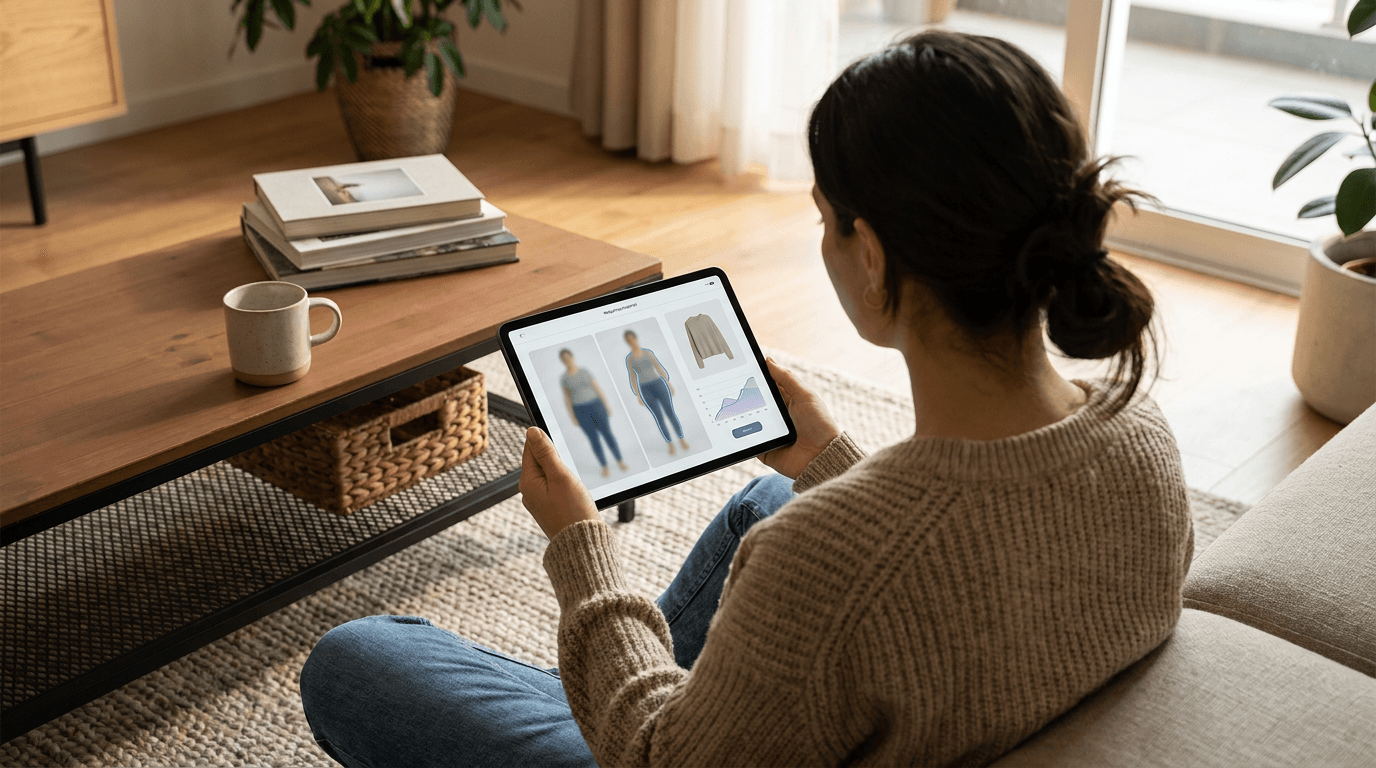
Yes, in the form of a virtual fitting room. A shopper enters body measurements once to build a 3D avatar, then previews how a specific garment's cut and sizing would fit that avatar before buying. The feature began as a pilot with Levi's in April 2023, was enhanced with the 3D avatar and expanded to 14 European markets in October 2024, and launched at a larger scale for all customers in 2026.
How much did returns actually drop?
- Pilot number, 40 percent: Zalando's director of applied science reported a 40 percent drop in returns following the April 2023 Levi's pilot, concentrated in jeans, a category with one of the highest size-related return rates in fashion.
- Scaled number, 8 percent: as the feature expanded beyond the original curated pilot into a wider slice of Zalando's catalog through 2025, size-related returns fell 8 percent, a smaller figure because it covers far more products, styles, and fit variation than a single-brand pilot.
Both numbers are real, and they are not the same claim. The 40 percent figure describes a concentrated, single-brand test in a category built for the technology to shine. The 8 percent figure describes what happened once the same idea had to work across a much messier, real catalog. Reporting on virtual try-on tends to quote whichever number sounds better without saying which one it means; here both are on the record with what each actually measures.
What about conversion rate?
Zalando has not published one. Every piece of its own reporting on the virtual fitting room, and every outlet that has covered it, including Vogue Business and WWD, talks about returns, not conversion. That is a deliberate gap: a company this size, with an applied science team capable of measuring a 40 percent return drop precisely, would very likely have a conversion number internally if that number were flattering enough to publish.
General industry data on virtual fitting rooms, not specific to Zalando, has cited conversion lifts in the 13 to 16 percent range. That figure belongs to the wider category of virtual try-on tools, not to a Zalando result, and it should not be quoted as if Zalando confirmed it.
How does the virtual fitting room actually work?
- April 2023: pilot launches with Levi's, using body measurements to estimate fit, tested across multiple European markets.
- October 2024: Zalando adds a persistent 3D avatar built from those measurements and expands the pilot to 14 European markets, still centered on a curated Levi's selection.
- 2026: the experience launches at a larger scale for all customers, building on three years of pilot data. More than 1.5 million customers have tried it.
The mechanism is measurement-based, not photo-based. A shopper's body is represented as a 3D avatar built from entered measurements, and Zalando simulates how a garment's pattern and sizing data would drape on that avatar. No photo of the shopper is generated or shown.

How is this different from photo-based AI try-on?
- Zalando simulates fit on a 3D avatar built from entered body measurements. No photo of the shopper is used or generated.
- Macy's built virtual try-on into a conversational assistant, Ask Macy's, that generates a preview from a shopper's own photo. See does Macy's have virtual try-on.
- Walmart built proprietary rendering technology after acquiring the startup Zeekit, covering hundreds of thousands of items through its own model tools. See does Walmart have virtual try-on for clothes.
- ASOS offers a hybrid option, a shopper's own photo or one of several AI-generated digital models. See does ASOS have virtual try-on.
- Amazon limits its version to a narrow set of categories: shoes, eyewear, and select t-shirts. See does Amazon have virtual try-on for clothes.
Measurement-based and photo-based approaches are solving the same underlying problem, not knowing how a garment will fit or look, from two different starting points. Zalando's approach needs a shopper to input accurate measurements once and trusts pattern data to do the rest. A photo-based approach needs no measurement input at all, and shows the garment on the person themselves, which is closer to what a fitting room mirror would show.
What does this mean if you don't have Zalando's resources?
Zalando spent three years and a dedicated applied science team building a proprietary fitting simulation from scratch. That is not a realistic bar for most fashion brands, and it does not need to be. The result Zalando is chasing, a shopper who trusts the size they're about to buy, is available today through a photo-based virtual try-on tool that installs directly on a store's existing product pages, no in-house research team required.
Corlen puts AI virtual try-on directly on a merchant's own Shopify or WooCommerce product pages, generated from a shopper's own photo rather than entered measurements, live in minutes instead of years. Developers building something more custom can start with the API docs. If returns from size uncertainty are the real cost you're trying to shrink, the return cost calculator is a fast way to see what that's actually worth solving for your own store.
See it on your own photo: try Corlen for free, no account needed for a first result.
Frequently asked questions
Does Zalando have virtual try-on for clothes?
Yes. Zalando calls it a virtual fitting room: a shopper enters body measurements to build a 3D avatar, then previews how a garment's cut and sizing map onto that avatar. It started as a Levi's pilot in April 2023, expanded to 14 European markets in October 2024, and launched at a larger scale for all customers in 2026. More than 1.5 million customers have already tried it.
How much did Zalando's virtual try-on actually reduce returns?
Zalando's director of applied science reported a 40 percent drop in returns following the April 2023 Levi's pilot, concentrated in jeans, a category with one of the highest size-related return rates in fashion. A separate, broader figure as the feature scaled put size-related returns down 8 percent across more of Zalando's catalog in 2025, a smaller number because it covers a wider, less curated set of products than the original pilot.
What was Zalando's conversion rate after adding virtual try-on?
Zalando has not published a conversion rate figure for this feature. Its own reporting and the trade coverage around it, including Vogue Business and WWD, focus entirely on returns. General industry data on virtual fitting rooms, not specific to Zalando, has cited conversion lifts in the 13 to 16 percent range, but that number belongs to the broader category, not to a disclosed Zalando result.
How does Zalando's virtual fitting room actually work?
It is measurement based, not photo based. A shopper inputs body measurements once to generate a reusable 3D avatar, and Zalando simulates how a specific garment's pattern and sizing would fit that avatar. That is different from AI tools that generate a photorealistic image of a shopper actually wearing a garment, starting from their own photo.
Can another retailer copy what Zalando built?
Not directly. Zalando's virtual fitting room is proprietary technology built for its own catalog, app, and years of applied science work. A merchant on Shopify or WooCommerce needs its own virtual try-on tool, like Corlen, installed on its own product pages to offer anything comparable to its own customers.
Ready to add real try-on to your store?
Install Corlen on Shopify in minutes, or build it into your own platform with the developer API.
Similar posts
Does Snapchat Have Virtual Try-On for Clothes?
Snapchat has run AR try-on since 2021: Camera Kit shoe lenses, in-store AR Mirrors. Here is what it covers and how it differs from AI try-on.
Read articleTrendsDoes Macy's Have Virtual Try-On for Clothes? Inside Ask Macy's
Macy's built virtual try-on into Ask Macy's, a shopping assistant powered by Google Gemini that works online and in physical stores. Here is what it covers.
Read articleTrendsDoes H&M Have Virtual Try-On? Its NeXR Pilot and Google Partnership
H&M tested an in-store body-scan avatar with NeXR, then became a launch partner for Google's AI try-on. Here is what each one actually covered.
Read articleSee it on your own photo
Corlen shows your customers how any garment looks on their own body, in seconds. Try it free, no account needed.
Try Corlen free