Virtual try-on for maternity clothing: why sizing is a moving target

Quick answer
Buying maternity clothing online means guessing twice. First against a size chart that may or may not reflect your actual measurements, then against a body that will keep changing for months. Most fit guidance, virtual try-on included, only ever solves the first problem.
Why is maternity sizing so hard to gauge online?
A regular size chart already struggles to describe how a garment sits on a body it has never measured. Maternity sizing adds a second axis on top of that: the body itself is a moving target, and a size that fits well in week 14 can be tight by week 28.
Consumer coverage of maternity shopping keeps landing on the same complaint. A 2026 Marie Claire piece on maternity wear, written by a pregnant editor testing the category firsthand, describes fit failures shoppers run into again and again: pieces that do not fully cover the stomach, waistbands that roll down instead of staying put. Those are not rare manufacturing defects. They are what happens when a garment is designed around an assumption about the body that turns out to be wrong for a lot of real shoppers.
Why do brands size maternity clothing so differently?
There is no shared industry convention for how a maternity size label should work, and that gap shows up in a specific, checkable way.
- Some brands size off your pre-pregnancy size. A shopper who wore a Medium before pregnancy buys a maternity Medium, and the garment is cut to expand around that starting point.
- Other brands size off current measurements. The same shopper at 20 weeks might need a Large from a brand that sizes this way, even though nothing about her pre-pregnancy size changed.
- Neither approach is labeled clearly at the point of sale. A shopper usually cannot tell which convention a brand is using until the order already arrived, which is exactly the kind of ambiguity that drives the order-multiple-sizes-and-return-what-does-not-work pattern covered in fashion ecommerce return statistics.
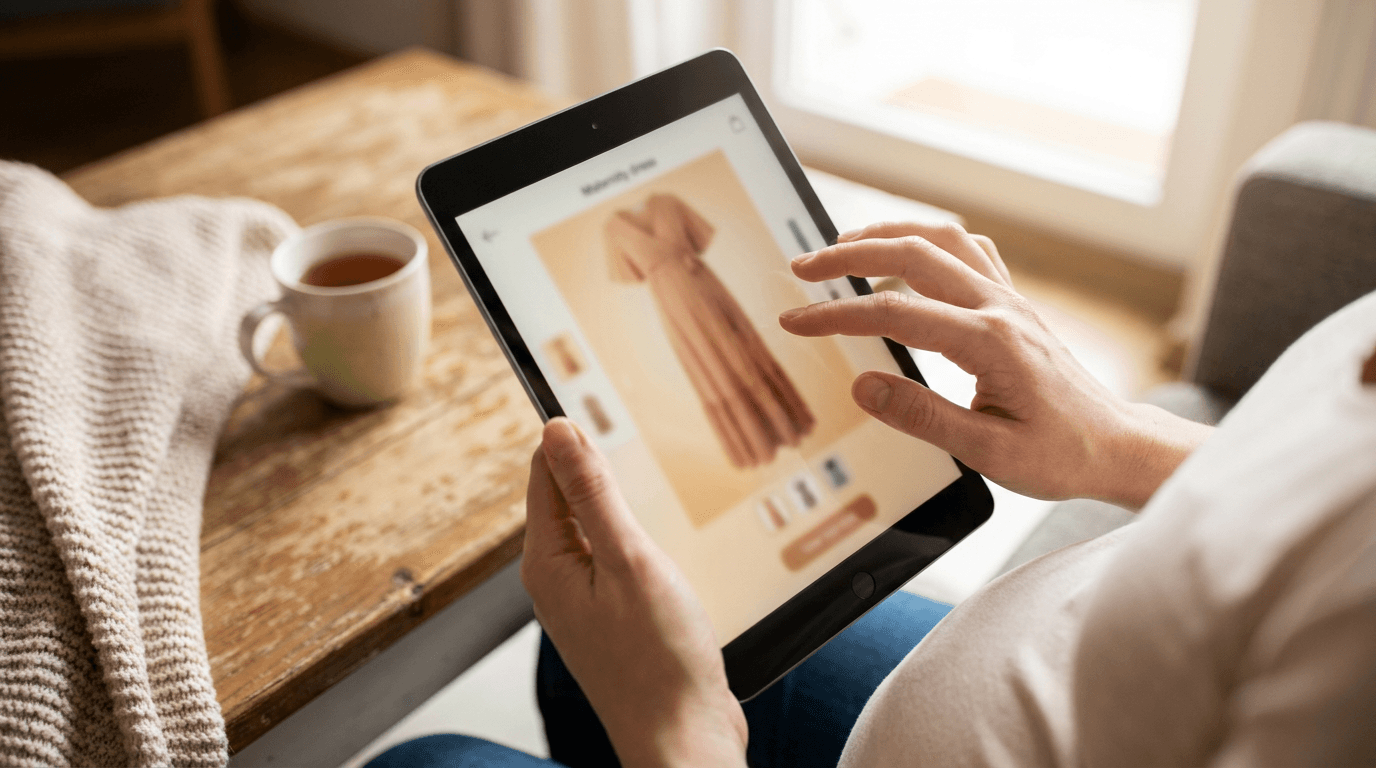
What can a fit preview actually answer for a pregnant shopper?
A body-size-aware virtual try-on renders a garment against the shopper's own photo and body size, not a generic model. For maternity shopping specifically, that answers a narrower but still useful question: given how this piece is cut, and given your body as it is right now, does the fabric have room, or does it look like it is already at its limit.
A structured, fitted top and a relaxed, gathered one can carry the exact same size label and still behave nothing alike once the body underneath is changing week to week. Seeing the drape and the amount of visible ease before checkout beats a size chart alone, even accounting for the fact that it is a signal about today, not about month eight.
What can it not answer, and how should you shop around that?
No fit tool should claim to predict a body that has not changed yet. A photo taken in the first trimester tells you nothing certain about fit in the third, and any tool that implies otherwise is overselling what a single image can do.
- Use a current photo, not one from before pregnancy or from an earlier stage, so the preview reflects the body the garment actually has to fit today.
- Favor styles built with visible room to grow, gathered waists, wrap fronts, stretch panels, and check whether the preview still shows comfortable ease rather than a fit that already looks snug.
- Re-check a piece you plan to wear for months at a later point in pregnancy if you can, the same way you would revisit a size chart rather than trust a single early measurement for the whole term.
- Read the return policy before checkout regardless of what the preview shows. A fit preview lowers the odds of a wrong order; it does not remove the need for a policy that still lets you return one if your body outpaces the garment.
How does Corlen handle maternity fit rendering?
Corlen does not have a pregnancy-specific mode, and it would be dishonest to imply otherwise. What it has is the same body-size-aware system behind every category on the platform: a shopper selects their own body size separately from the garment's size, and Corlen renders the visible difference between the two rather than relabeling one generic shape. For the mechanics behind that comparison, see virtual try-on for plus size clothing, which covers the same rendering approach in more depth, and is virtual try-on accurate for what else affects result quality beyond body size.
On a Shopify store, this runs directly on the product page through Corlen's Shopify app, so a maternity shopper can check a real preview before adding to cart instead of guessing from a flat product photo. Teams building on a different platform get the same generation engine through the developer API.
See it on your own photo first: try Corlen for free, no account needed for a first result.
Frequently asked questions
Does virtual try-on work for maternity clothing?
It can help with the same question it answers for any garment: how a specific piece sits against your actual body shape right now, rather than a size chart's flat description. It renders fit against your current photo, not a prediction of how you will look at a later stage of pregnancy.
Why is maternity sizing so inconsistent across brands?
Some brands size maternity clothing off your pre-pregnancy size, others size off current measurements, and there is no shared industry standard for either approach. That inconsistency is on top of the usual brand-to-brand variation every apparel category already has.
Can a photo from early pregnancy predict how a garment will fit later?
No, and no fit tool, virtual or otherwise, should claim it can. A photo captures your body at the moment it was taken. For a piece meant to last several months, that is one useful data point, not the whole picture.
Does Corlen have a pregnancy-specific mode?
No. Corlen renders any garment against your current photo and your selected body size, the same body-size-aware system it uses for every shopper. It does not simulate future body changes or offer a trimester setting.
How does Corlen handle body size for maternity shoppers?
The same way it does for every category: a shopper picks their own body size separately from the garment's size, and Corlen renders the visible difference, whether that means a fitted piece pulling at the seams or a relaxed cut draping with room to spare.
Ready to add real try-on to your store?
Install Corlen on Shopify in minutes, or build it into your own platform with the developer API.
Similar posts
Virtual Try-On for Lingerie and Intimates Stores: What Works
Running a lingerie or intimates store? Photo try-on is the wrong tool for bras and briefs, but it can sell your loungewear and robes. Here is the honest split.
Read articleGuidesVirtual Try-On for Headless Shopify and Hydrogen Stores
Running Shopify headless or on Hydrogen? Theme app blocks may not reach a custom storefront. See how try-on works there, using an API and a server route.
Read articleGuidesVirtual Try-On for Wix and Squarespace Stores: Your Options
Selling clothes on Wix or Squarespace? See how try-on works on a site builder: app market apps, embed code, or an API, and what to check before you pay.
Read articleSee it on your own photo
Corlen shows your customers how any garment looks on their own body, in seconds. Try it free, no account needed.
Try Corlen free