Does the US Require an AI Label on Virtual Try-On? SB 942 and the FTC, Explained
Quick answer
US retailers weighing AI disclosure often reach for the EU AI Act first, since it names the obligation directly. That rule reaches a US store selling into Europe, covered in an earlier post on the EU AI Act's disclosure requirement, but a domestic US store needs a different map. Two things changed on the US side in 2026, and they land on different parties.
What is SB 942 and what changed on August 2, 2026?
SB 942, the California AI Transparency Act, was signed in 2024 with an original start date of January 1, 2026. AB 853, signed October 13, 2025, pushed that date to August 2, 2026, deliberately lining it up with the EU AI Act's own enforcement timeline for high-risk systems.
From that date, a covered provider under SB 942 has three obligations: offer a free public tool that lets anyone check whether a piece of content came from its system, give users the option to add a visible manifest disclosure to AI generated images, and embed a latent disclosure, hidden provenance data, in content its system creates. A second wave of obligations aimed at large online platforms and AI hosting platforms is scheduled for January 1, 2027, under the same amendment.
Who does SB 942 actually apply to: platforms or retailers?
SB 942 defines a covered provider narrowly: an entity that builds a generative AI system with more than one million monthly users in California. That threshold sweeps in the handful of companies operating foundation models at that scale, Google, OpenAI, Anthropic, Meta, and comparable image and video generation platforms.
- A fashion retailer buying a try-on tool is a customer of a covered provider, not one itself. The one million monthly user threshold is built for scale, so a store running virtual try-on on its product pages does not carry SB 942's disclosure duties directly, even though the images it shows are AI generated.
- The obligation sits with whoever built the underlying model. Corlen's own generation engine runs on Google's Gemini image model family, which is squarely inside SB 942's scope as a covered provider in its own right. That does not transfer SB 942's specific duties down to a retailer using a tool built on top of it.
- This is a different structure from the EU AI Act. The EU rule puts its disclosure duty on the deployer, meaning the business showing the content to a shopper. SB 942 puts its main duties on the provider building the system. A US-only store can be effectively outside SB 942's direct reach while still needing to think about disclosure for an entirely separate reason, covered next.
What does the FTC require separately from SB 942?
SB 942 is a California statute naming AI specifically. The FTC's authority is older and broader: Section 5 of the FTC Act bars unfair or deceptive practices, and it does not need a new AI-specific law to reach an AI generated image that misleads a shopper about what they are buying.
In January 2026 the FTC stood up a dedicated AI enforcement unit and raised its maximum penalty to over 53,000 dollars per violation. Its updated Endorsement Guides now treat AI-generated content as its own disclosure category, separate from the older paid-endorsement disclosure a store may already run. A post marked as an advertisement does not also cover the AI generated question, and a label that says AI generated does not also cover the commercial relationship question. Both have to be present where either applies.
The FTC's standard for what counts as adequate disclosure has stayed consistent across years of guidance: clear, conspicuous, and visible at the moment a person encounters the content, not a click away in a bio or a policy page. A retailer showing a shopper an AI generated try-on result without saying so is closer to this exposure than to SB 942's.
What should a US fashion retailer actually do?
- Label every AI generated image visibly, on the image itself or immediately beside it, rather than in a footer disclaimer a shopper is unlikely to read.
- Say plainly that a virtual try-on result is a preview, not a guarantee of exact fit, color, or fabric, so the disclosure covers both the AI generated question and the accuracy expectation at once.
- Do not rely on a vendor's own AI watermark or metadata as a substitute for a visible label on the retailer's own product page. SB 942's latent disclosure lives inside the file and is built for detection tools, not for a shopper glancing at a page.
- Check whether the store also sells into the EU. If it does, the separate deployer obligation under the EU AI Act's Article 50 applies on top of anything covered here, not instead of it.
None of this is legal advice, and neither law hands a retailer a template to copy. A store with real exposure, meaning real EU sales or a marketing claim that could plausibly mislead a shopper about a product's actual appearance, should confirm its approach with counsel rather than assume either law's silence means no obligation exists.
How does Corlen handle AI-generated disclosure today?
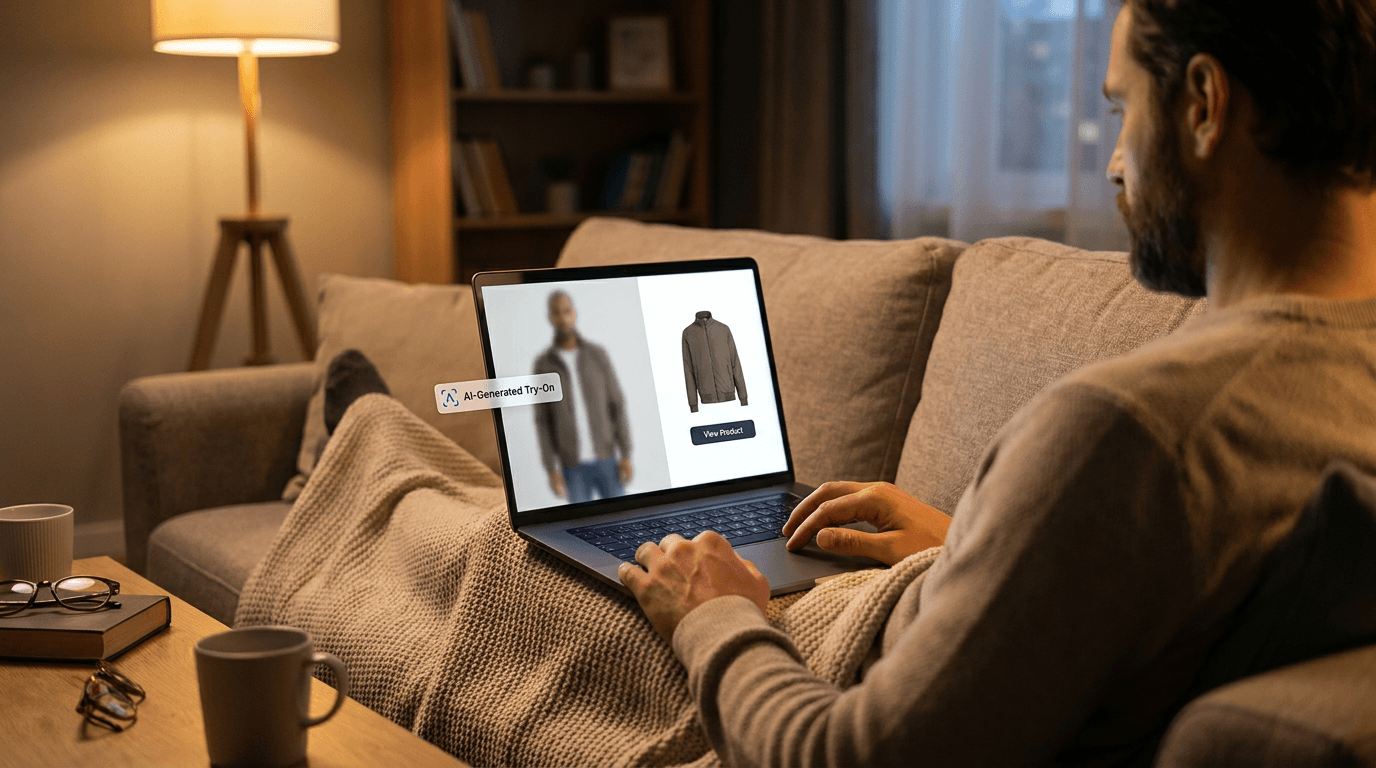
Corlen labeled its outputs before either 2026 rule arrived. Every result on the in-store kiosk carries a visible AI GENERATED PREVIEW label directly on the image, and Corlen's terms state that a preview is an approximation, not a guarantee of exact fit, color, or fabric appearance. That was a product decision made for trust with shoppers, not a response to SB 942 or the FTC's enforcement push, and it happens to line up with what both now expect.
On a Shopify store, virtual try-on runs directly on the product page through Corlen's Shopify app, with the same visible label built into every result. A team building on WordPress or a custom stack gets the same generation and labeling behavior through the developer API instead, so the disclosure travels with the image rather than depending on a merchant remembering to add it separately.
For the EU side of this same question, see the earlier post on the EU AI Act's virtual try-on disclosure rule. For what actually happens to a shopper's photo rather than how the finished result gets labeled, see is virtual try-on safe.
See the label in place directly: try Corlen on your own photo, no account needed for a first result.
Frequently asked questions
Does California's SB 942 apply to a small fashion retailer?
Almost certainly not directly. SB 942 defines a covered provider as a company that builds a generative AI system with more than one million monthly users in California. That threshold reaches foundation model builders like Google, OpenAI, Anthropic, and Meta, not a retailer buying a try-on tool built on top of one of those models. A retailer's exposure comes from a different law, the FTC's Section 5 rules on deceptive practices, covered below.
Is SB 942 the same law as the EU AI Act?
No, they are separate laws in separate jurisdictions, though their obligations became operative on the same date, August 2, 2026, a deliberate alignment by the California legislature. The EU AI Act's Article 50 puts a disclosure duty on the business showing AI content to shoppers. SB 942 puts its main duties on the AI system builder instead. A US store selling into the EU can be in scope of the EU rule even if SB 942 does not reach it at all.
What does the FTC actually require for AI generated product photos?
Under Section 5 of the FTC Act and the updated Endorsement Guides, showing an AI generated image in a way that misleads a shopper about the real product can count as a deceptive practice, whether or not any single AI-specific statute names the situation. The FTC's own standard for disclosure is that it has to be clear, conspicuous, and visible at the moment a shopper sees the content, not buried in a footer link or a terms page.
Does a virtual try-on preview count as a misleading product image?
Not inherently. A try-on result that clearly reads as a preview, and that a store does not present as an exact guarantee of fit or color, is a different case from an image edited to hide a product's real flaws. The safer practice is labeling every try-on result as an AI generated preview rather than leaving a shopper to guess whether they are looking at a photograph.
Does Corlen already label its outputs as AI-generated?
Yes. Every result on Corlen's in-store kiosk carries a visible AI GENERATED PREVIEW label directly on the image, and Corlen's terms state plainly that a preview is an approximation, not a guarantee of exact fit, color, or fabric. That labeling practice was already in place before either SB 942 or the FTC's 2026 enforcement push, and it covers Corlen's own surfaces regardless of which specific US law a merchant is weighing.
Ready to add real try-on to your store?
Install Corlen on Shopify in minutes, or build it into your own platform with the developer API.
Similar posts
Real-Time Virtual Try-On: What It Is and Whether Your Store Needs It Yet
Real-time virtual try-on renders clothing on a shopper's live camera feed instead of one photo. Here is what shipped in 2026, and what it means for your store.
Read articleTrendsDoes Zalando Have Virtual Try-On? Inside Its 40% Return Drop
Zalando's virtual fitting room cut returns 40% in a Levi's pilot and has now reached 1.5 million shoppers. Here is what the real numbers show.
Read articleTrendsDoes Snapchat Have Virtual Try-On for Clothes?
Snapchat has run AR try-on since 2021: Camera Kit shoe lenses, in-store AR Mirrors. Here is what it covers and how it differs from AI try-on.
Read articleSee it on your own photo
Corlen shows your customers how any garment looks on their own body, in seconds. Try it free, no account needed.
Try Corlen free