Does Australian Law Require Online Clothing Stores to Accept Returns?

Quick answer
This is a different structure from the UK, where a statutory cooling off period covers most online orders regardless of the reason. Australia's law works the other way around: strong guarantees when something is actually wrong with the item, and no general fallback when nothing is wrong except the shopper's own second thoughts.
Does Australian law require online clothing stores to accept returns?
For a faulty, unsafe, or misdescribed item, yes, and a store cannot opt out of this with its own policy. For an item that simply did not work out, no general legal right exists. That second case is the one that trips up both shoppers and stores, since it is easy to assume a right exists just because it does in other countries or on other platforms.
What are the consumer guarantees under Australian Consumer Law?
The Australian Consumer Law sets automatic consumer guarantees on every sale, regardless of what a store's own return policy says. These guarantees cannot be removed by a sign, a contract clause, or a store's terms and conditions.
- Acceptable quality. The item should be free of defects, safe, and durable enough for its normal use.
- Fit for the purpose described. If a listing states a use or feature the item does not actually have, that guarantee is not met.
- Matches its description. The item received should match what was shown and described at the time of purchase.
When one of these guarantees is not met, the size of the failure decides who chooses the remedy. A major failure lets the shopper choose between a refund and a replacement. A minor failure only entitles the shopper to a free repair, with the store deciding whether to also offer a replacement or refund.
Does a shopper have a right to return clothing just because they changed their mind?
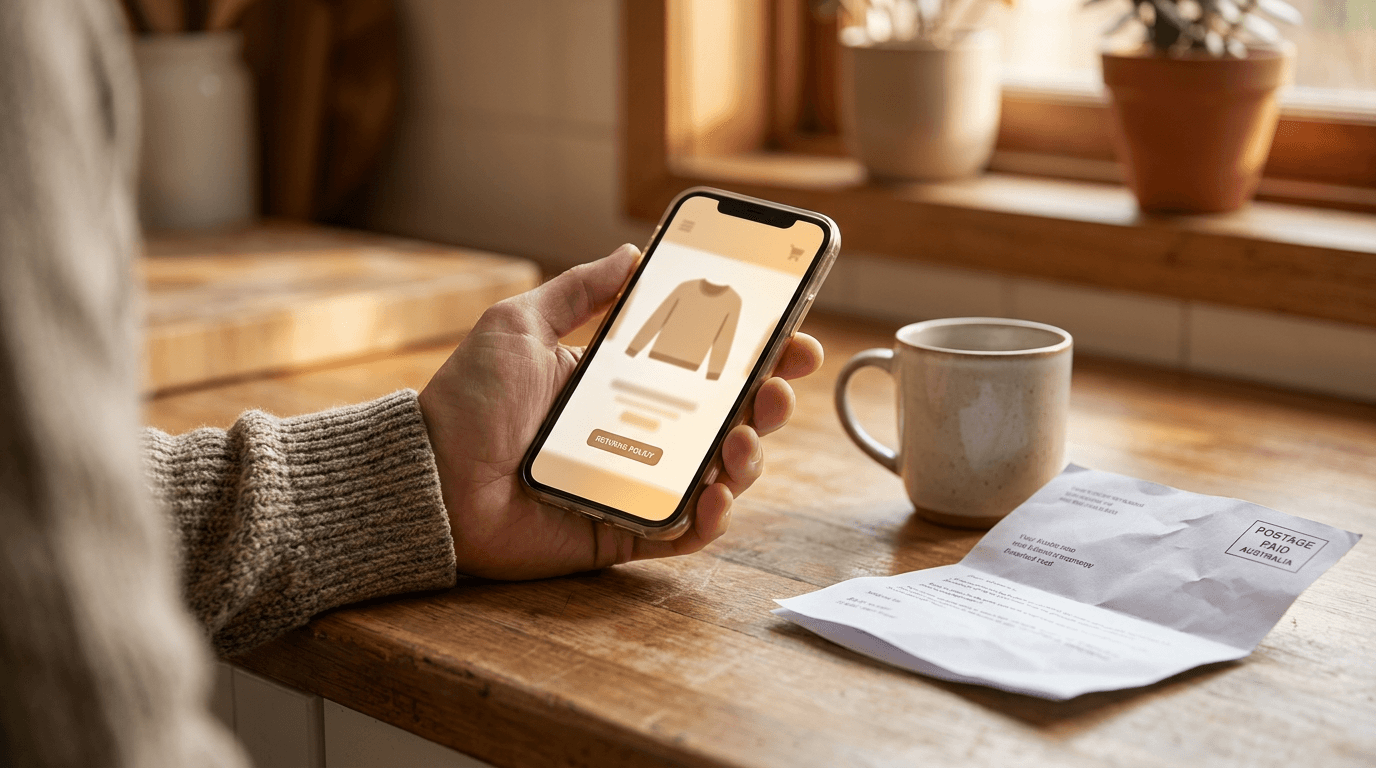
No. Ordering the wrong size, deciding the color does not suit, or simply finding it cheaper elsewhere are all outside the consumer guarantees. If a store chooses to offer a change of mind return as a customer service policy, it has to honor whatever terms it advertises, such as a 14 day exchange window, but nothing in the Australian Consumer Law forces a store to offer that policy in the first place.
That gap is the practical reason fit accuracy matters more for an Australian clothing store than a UK one selling the same garments. A UK shopper who guesses wrong on size has a statutory fallback. An Australian shopper in the same position is relying entirely on whichever return policy the store decided to offer.
Can a store legally tell shoppers 'no refunds'?
Not as a blanket statement. A flat 'no refunds' sign implies refunds are never available under any circumstance, which misrepresents a shopper's guaranteed rights for a faulty or misdescribed item and can breach the Australian Consumer Law's rules against misleading conduct. The consumer watchdog has acted on exactly this: Coles and Woolworths both removed misleading 'no refunds' signage on reduced-to-clear stock after regulatory scrutiny, and a separate business, Koala & Tree Pty Ltd, was fined for making false claims about consumers' remedy rights on faulty products.
- A sign that says refunds are never given under any circumstance is not compliant, since it overstates what a store can actually withhold.
- A sign limited to change of mind specifically, stating that change of mind returns are not offered, is accurate and compliant, since that is optional under the law.
- A faulty or misdescribed item is covered by the consumer guarantees no matter what any sign says, and a store cannot point to its own posted policy to avoid that obligation.
How does virtual try-on fit in for an Australian store?
Since Australian shoppers have less of a legal fallback for an ordinary sizing mistake than shoppers in the UK, getting the fit right before checkout matters more, not less. Corlen lets a shopper upload a photo and see a garment rendered on their own body before buying, whether that is on a store's Shopify product page or through the developer API on a custom platform. The full breakdown of the UK's own statutory return right, for comparison, is in what UK law requires online clothing stores to accept as a return.
See it on your own photo first: try Corlen for free, no account needed for a first result.
Frequently asked questions
Does Australian law require online clothing stores to accept returns?
Only in specific cases. The Australian Consumer Law guarantees a refund, replacement, or repair when clothing is faulty, not of acceptable quality, or does not match what was described. It does not give a shopper a general legal right to return an item just because they changed their mind.
Is there an Australian equivalent to the UK's 14 day cooling off right?
No, not for a standard online clothing purchase. The UK gives shoppers a statutory cooling off period for most online orders. Australia has no equivalent general right: a change of mind return is only available if the store's own policy offers one, and the store can set its own conditions on that policy.
Can an Australian store legally post a 'no refunds' sign?
Not as a blanket statement. A sign or policy implying refunds are never available under any circumstance risks breaching the Australian Consumer Law's rules against misleading conduct, since it misstates a shopper's guaranteed rights for faulty or misdescribed goods. A sign limited to change of mind, stating that change of mind returns specifically are not offered, is accurate and compliant.
Who pays the return shipping cost in Australia?
It depends on why the item is being returned. If the store is at fault, meaning the item is faulty or not as described, the store covers the return cost. If the shopper is returning for a reason the store is not legally required to accept, such as a simple change of mind, the shopper typically pays for return postage, if the store offers a return at all in that case.
Does virtual try-on reduce the need for returns in Australia the same way it does elsewhere?
The underlying problem is the same everywhere: a shopper guesses at fit from a product photo and a size chart, then finds out after delivery whether the guess was right. A fit preview against the shopper's own photo addresses that guesswork regardless of which country's return law applies, which matters more in Australia specifically since a shopper has less legal fallback if a change of mind purchase turns out wrong.
Ready to add real try-on to your store?
Install Corlen on Shopify in minutes, or build it into your own platform with the developer API.
Similar posts
Does Virtual Try-On Work for All Skin Tones?
AI virtual try-on can shift skin tone the same way any generative model can. Here is why it happens, what a photo based tool changes, and what to check.
Read articleGuidesVirtual Try-On for Workwear and Uniforms: Fixing Bulk Sizing Without Guesswork
Bulk uniform orders go wrong more than regular retail, and reissues cost more than the original order. Here is how a photo based fit preview helps.
Read articleGuidesBuild vs Buy: Should You Build Your Own Virtual Try-On AI?
Weighing an in-house virtual try-on model against an API or app. What building it yourself actually requires, and when that effort is worth it.
Read articleSee it on your own photo
Corlen shows your customers how any garment looks on their own body, in seconds. Try it free, no account needed.
Try Corlen free