Virtual try-on for secondhand clothing: why fit matters more in resale

Quick answer
New retail has spent years building fit tools: size charts, size recommendation quizzes, generous return windows. Resale grew up without most of that, and it is now big enough that the gap is starting to matter.
How big is the secondhand clothing market right now?
ThredUp's 2026 report puts the global secondhand apparel market at 257 billion dollars in 2025, up 13 percent year over year, on track for 393 billion dollars by 2030. The US portion alone is expected to reach 78.8 billion dollars by 2030. Online resale specifically, the part a shopper reaches through a website rather than a physical thrift store, is projected to nearly double from 29.7 billion dollars in 2025 to 48.3 billion dollars by 2030. Fifty nine percent of US consumers shopped secondhand apparel in 2025, a share that keeps climbing.
That growth is not evenly split. A large share runs through peer to peer marketplaces such as Poshmark, Depop, Vinted, and eBay, where one person lists one item they own. A smaller but growing share runs through curated resale and vintage retailers, businesses that source, grade, and photograph secondhand pieces and sell them through their own storefront the way any other online store does.
Why don't most resale marketplaces accept returns for fit?
Poshmark's policy is direct about it: the platform does not accept returns for buyer's remorse, and fit specifically is named as a reason that does not qualify. A buyer can only open a formal case if an item is not as described, meaning the wrong size or color was listed, undisclosed damage, or the item never arrived. Simply not liking how it fits is not grounds for a return.
New retail can absorb a fit return because the item goes back on the shelf and sells to the next customer. A secondhand item is usually a single unit. Every reship and relist cycle costs the seller time and condition on a piece that cannot simply be reordered from a warehouse, so most resale platforms draw the return line earlier than a typical new retail store would.
Why is fit harder to judge on a one of one resale item?
- There is no second unit to fall back on. A new retailer might stock the same shirt in five sizes. A resale listing is usually the only one of that exact piece, so getting the size wrong once often means the item is gone entirely, not just the wrong size.
- Vintage sizing does not track modern size charts. A garment tagged decades ago can run smaller or larger than the same labeled size today, and the listing rarely explains by how much.
- Wear and washing change the actual measurements. A used garment has often shrunk, stretched, or been altered in ways a new item straight from a factory has not, so even a correct original size tag can be misleading.
- The photo is almost always the only reference. Fit and sizing already drive an estimated half to seventy percent of apparel returns, as covered in our post on fashion ecommerce return statistics, and that is with brand new items that at least have a consistent size chart behind them. Resale has the same core fit problem with fewer of the usual guardrails.
What would a fit preview actually change for a resale buyer?
ThredUp itself has already tried to solve part of this the physical way. Its Goody Box service ships a personalized box of ten to twenty secondhand items to a buyer's home for a flat fee, closer to a try before you buy service than a normal checkout. It works, but it takes days to arrive and costs money up front regardless of whether anything gets kept.
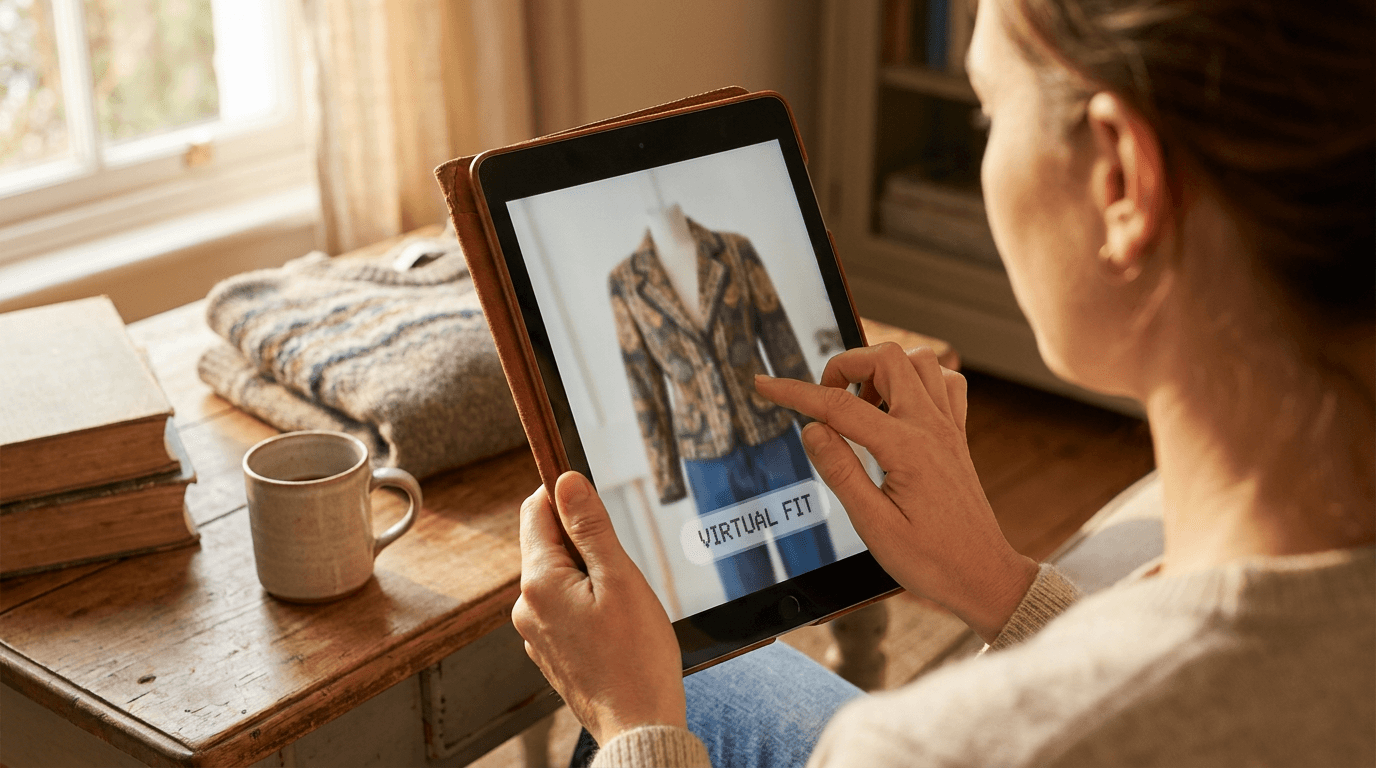
A virtual preview solves the same uncertainty before checkout instead of after it ships. A shopper's own photo and the garment's photo produce a rendered result showing how that exact piece sits on that person, in seconds rather than days, with nothing to return if it does not work out because nothing has been ordered yet.
How does Corlen work for resale and vintage retailers?
Peer to peer marketplaces are not where this fits today. An individual seller listing a dress on Poshmark or Vinted has no product page of their own to add a tool to. Curated resale and vintage retailers running a real storefront are different: on Shopify, Corlen's app adds a try on button directly to the product page, the same as it would for any new garment. Teams building a custom resale storefront can reach the same rendering engine through the developer API.
The render itself works the same regardless of whether the garment is new or secondhand, since it is only reading the garment photo and the shopper's photo, not a size chart or a brand's history. See the full generation process in how virtual try-on works.
See it directly first: try Corlen on your own photo, no account needed for a first result.
Frequently asked questions
Can virtual try-on work with secondhand or vintage clothing?
Yes. The mechanism does not care whether a garment is new or used. It only needs one clear photo of the piece, front on, similar to how it needs one photo for any new item. For a one of a kind vintage find, that photo is often the only preview a buyer will ever get before it ships.
Do marketplaces like Poshmark, Vinted, or Depop offer virtual try-on?
Not currently, and there is a practical reason: those are peer to peer marketplaces, so an individual seller listing one dress has no way to add a script or a widget to their own listing page. Virtual try-on shows up on storefronts instead, curated resale and vintage shops running their own Shopify or WooCommerce store, where the retailer controls the product page.
Why won't resale platforms take a return just because something doesn't fit?
Because the economics are different from new retail. A new item can go back on the shelf and sell again. A secondhand piece that gets returned, reshipped, and relisted loses condition and time with every round trip, so most platforms draw the line at fit and buyer's remorse and only step in when an item is not as described.
Does vintage sizing match a modern size chart?
Often not closely. Sizing conventions have shifted over decades, so a garment tagged a specific size from an earlier era can run smaller or larger than the same number today. A size chart alone does not carry that history. A render of the actual piece against a buyer's own photo does not need to.
How does Corlen work for a resale or vintage storefront specifically?
The same way it works for a new item: a photo of the garment and a photo of the shopper go in, a rendered preview comes out. There is no separate mode for used clothing, because the model does not need one, it renders whatever garment photo it is given.
Ready to add real try-on to your store?
Install Corlen on Shopify in minutes, or build it into your own platform with the developer API.
Similar posts
Real-Time Virtual Try-On: What It Is and Whether Your Store Needs It Yet
Real-time virtual try-on renders clothing on a shopper's live camera feed instead of one photo. Here is what shipped in 2026, and what it means for your store.
Read articleTrendsDoes Zalando Have Virtual Try-On? Inside Its 40% Return Drop
Zalando's virtual fitting room cut returns 40% in a Levi's pilot and has now reached 1.5 million shoppers. Here is what the real numbers show.
Read articleTrendsDoes Snapchat Have Virtual Try-On for Clothes?
Snapchat has run AR try-on since 2021: Camera Kit shoe lenses, in-store AR Mirrors. Here is what it covers and how it differs from AI try-on.
Read articleSee it on your own photo
Corlen shows your customers how any garment looks on their own body, in seconds. Try it free, no account needed.
Try Corlen free