Does New York's AI Advertising Law Cover Virtual Try-On? The Synthetic Performer Rule, Explained

Quick answer
New York became the first state to require a specific disclosure for AI generated performers in advertising. For a fashion retailer already running virtual try-on, or weighing whether to add it, the natural question is whether a customer's own generated preview counts as the kind of ad the law is talking about. The law was written for a different problem. Here is exactly where the line sits.
What does New York's synthetic performer law say?
The law is S.8420-A/A.8887-B, signed in January 2026 and effective June 9, 2026. It amends New York General Business Law section 396-b and requires a conspicuous disclosure in any advertisement that includes a synthetic performer, defined as a digitally created asset, made using generative AI or a comparable algorithm, intended to create the impression of a human performer who is not recognizable as any identifiable natural person.
- Actual knowledge standard: the disclosure duty applies where the advertiser has actual knowledge the ad includes a synthetic performer, not a strict liability standard that reaches every possible case.
- Not tied to any particular technology: the law does not name generative AI models specifically. Any tool used to fabricate a convincing but fake human image can trigger it.
- Platforms are exempt: media platforms and publishers that only host someone else's ad, such as a newspaper, streaming service, or television network, are expressly carved out of liability.
- No fixed format: the statute does not specify exact wording, size, or placement for the disclosure, leaving that to the advertiser, though guidance points advertisers toward the FTC's existing clear and conspicuous standard.
Does a virtual try-on result count as a synthetic performer?
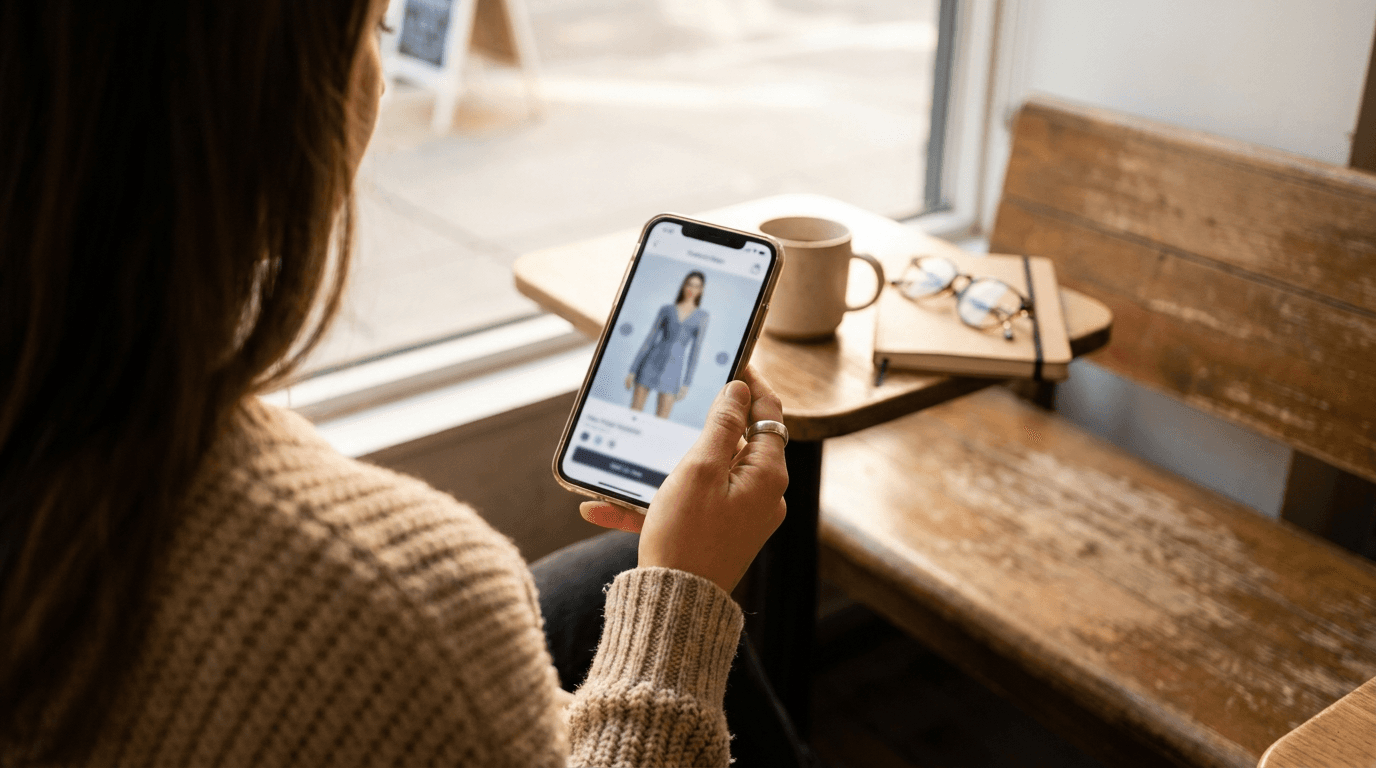
The definition is the key detail here. A synthetic performer under this law has to create the impression of a performer who is not recognizable as any identifiable natural person. A virtual try-on result does the opposite: it starts from a real, identifiable person's own photo and changes the garment, while the person themselves stays exactly who they are. That is the core design of how virtual try-on works, and it is why the shopper-facing use case reads as a poor fit for a law aimed at fabricated stand-ins.
This distinction matters because it is the same structural question raised by California's AI Transparency Act and the EU AI Act, covered in earlier posts on this blog: each law defines its target narrowly, and the specific wording decides whether a fashion retailer's own use case is actually in scope, rather than assuming any AI generated image automatically triggers every AI disclosure law that exists.
What about a store's own marketing images?
A separate question is a store's own advertising, not a customer's individual try-on result. If a retailer runs marketing creative built on a fully synthetic model, meaning an AI generated person who does not exist and is not an identifiable real individual, that image is a plausible fit for the synthetic performer definition and should be checked for disclosure.
- Identify whether any ad creative uses a fabricated, non-real model image rather than a photograph of a real person or a customer's own try-on result.
- If it does, add a conspicuous disclosure that the performer is AI generated, using the FTC's clear-and-conspicuous standard as the practical benchmark since the statute itself does not specify wording.
- Keep that separate from any labeling already applied to customer-facing try-on previews, since the two serve different purposes and, in New York's case, may sit under different legal reasoning.
- Track whether the ad reaches New York consumers specifically, since the law is a state statute rather than a federal one.
What are the penalties, and what counts as proper disclosure?
The civil penalty is 1,000 dollars for a first violation and 5,000 dollars for each one after that. The law leaves the exact form of the disclosure open, so legal commentary consistently points advertisers toward the same clear-and-conspicuous standard the FTC already applies elsewhere: readable, visible at the point a person sees the ad, and present long enough to actually register, rather than placed in a footer or a linked policy page.
How does this compare to California and the EU?
All three 2026 rules share a theme, disclosure for AI generated content that could mislead someone about what they are looking at, but each one draws its line differently. New York's law targets fabricated, non-real performers specifically. California's SB 942 mostly binds the companies building the underlying AI models rather than the retailers using them, covered in an earlier post on the California AI Transparency Act. The EU AI Act's Article 50 casts the widest net, putting a disclosure duty directly on the business showing AI generated content to a shopper if it could pass as real, covered separately in the post on the EU AI Act's virtual try-on disclosure rule.
The practical takeaway for a store selling into multiple markets is the same one from those earlier posts: check each law's actual scope rather than assuming any single label satisfies every jurisdiction at once. Corlen already labels every kiosk result as an AI GENERATED PREVIEW and states plainly in its terms that a preview is an approximation, not a guarantee of exact fit or color, a practice that predates all three of these 2026 rules.
None of this is legal advice. A retailer with real exposure in New York, meaning it runs ad creative reaching New York consumers, should confirm its specific approach with counsel rather than rely on a general explainer.
See how a labeled, transparent try-on preview actually looks: try Corlen on your own photo, no account needed. Selling on Shopify? Check the Shopify integration for adding it to your own product pages, or the developer API for a custom build.
Frequently asked questions
What is New York's synthetic performer disclosure law?
It is S.8420-A/A.8887-B, an amendment to New York General Business Law section 396-b. It requires a conspicuous disclosure on any advertisement that includes a synthetic performer, meaning a digitally created human image made with generative AI or a similar tool, where the advertiser has actual knowledge the performer is not a real, identifiable person. It took effect June 9, 2026.
Does a virtual try-on result count as a synthetic performer under the law?
In most cases, no. The law's definition specifically covers a performer who is not recognizable as any identifiable natural person. A virtual try-on result shows the shopper's own real photo with a garment rendered onto it, not a fabricated stand-in model, so it falls outside that definition for the shopper-facing use case.
Could a retailer's marketing images still need the disclosure?
Possibly, if a store uses a fully synthetic, non-real model in ad creative, such as an AI generated house model in a product photo or a demo image, rather than a real photographed person. That is a separate use case from a customer's own try-on result. A store running any synthetic-model marketing should check that specific creative on its own.
What are the penalties for not disclosing?
A civil penalty of 1,000 dollars for a first violation and 5,000 dollars for each subsequent violation. The law does not dictate an exact wording or placement, but legal guidance points to the FTC's clear and conspicuous standard: visible, readable, and on screen long enough to register, not buried in fine print.
How does this compare to California's and the EU's AI disclosure rules?
New York's law is narrower in a specific way: it targets fabricated, non-real performers in ads, not AI editing of a real person's own photo. California's SB 942 mostly binds large AI model builders rather than retailers, and the EU AI Act's Article 50 puts a broader disclosure duty on any business showing AI generated content that could pass as real, covered in an earlier post on the EU AI Act's virtual try-on disclosure rule.
Ready to add real try-on to your store?
Install Corlen on Shopify in minutes, or build it into your own platform with the developer API.
Similar posts
Does Amazon Have Virtual Try-On for Clothes? What It Covers and What It Does Not
Amazon's virtual try-on works for shoes, eyewear, and select t-shirts, not full clothing. Here is what shoppers and sellers actually get, and what is missing.
Read articleTrendsGoogle shut down Doppl. Here is what it means for virtual try-on
Google closed its standalone Doppl try-on app ten months after launch and folded the tech into Search. What that shutdown teaches any store betting on virtual try-on.
Read articleTrendsDo UK Retailers Need to Disclose AI Generated Try-On Images? ASA and CAP Code Rules
The UK has no standalone AI disclosure law, but the ASA polices AI generated fashion images under the CAP Code. Here is what a retailer has to do.
Read articleSee it on your own photo
Corlen shows your customers how any garment looks on their own body, in seconds. Try it free, no account needed.
Try Corlen free