AI Virtual Try-On vs AR Filters: What's the Difference?
Quick answer
Both get called virtual try-on, and stores selling both accessories and clothing sometimes end up with one when they actually need the other. The two work on completely different principles, and that difference decides which one is worth building into a product page.
What is the core difference between AR and AI virtual try-on?
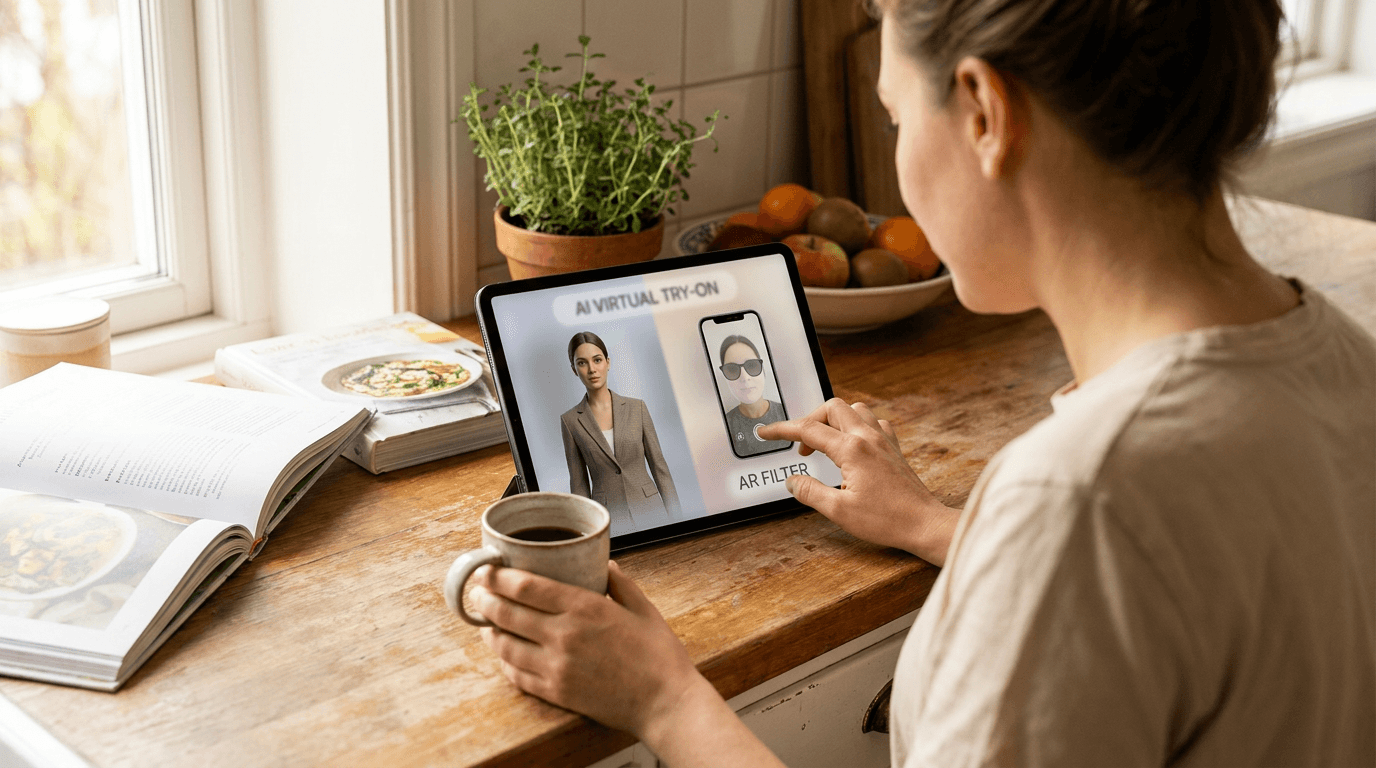
AR (augmented reality) try-on places a digital object on top of your camera feed and tracks it as you move, the way a phone camera can put a hat on your head in real time. AI virtual try-on skips the camera feed entirely. You upload one photo, and an AI model generates a new image of you wearing the item, calculated once rather than rendered continuously.
| AR filters | AI virtual try-on | |
|---|---|---|
| How it renders | Overlays a digital object on a live camera feed | Generates a new image of you wearing the garment |
| Needs a live camera | Yes, continuously | No, one photo is enough |
| Best suited for | Glasses, hats, makeup, jewelry | Clothing, jackets, full outfits |
| Simulates fabric drape | No | Yes |
| Speed | Instant, updates as you move | A few seconds per generated result |
How do AR try-on filters actually work?
An AR filter tracks landmarks on your face or hand through your phone or laptop camera: the bridge of your nose, the corners of your eyes, the position of your wrist. It uses those points to anchor a 3D model of a product, glasses, a lipstick shade, a watch, and redraws it in the right place dozens of times a second as you move.
That's well suited to a small, predictable target. A face stays roughly the same shape while you tilt your head. A wrist stays roughly cylindrical no matter how you turn it. The tracking problem is bounded, which is why AR try-on for eyewear and beauty has worked well for years.
How does AI virtual try-on generate a result?
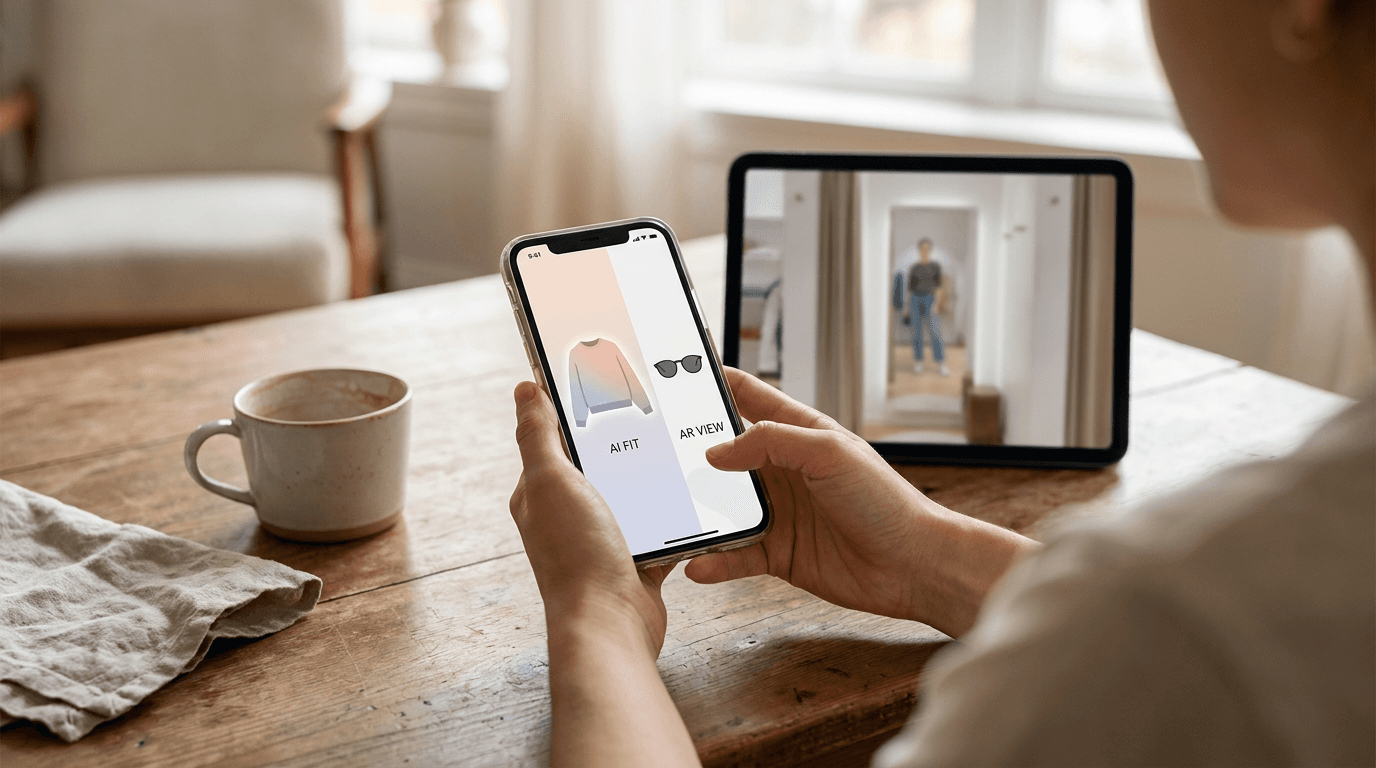
AI virtual try-on takes a completely different path. You submit one photo of yourself and one photo of a garment. An image generation model, the same underlying technology behind tools like Google's Nano Banana image models, analyzes your pose, body shape, and proportions in that photo, then produces a new image showing the garment fitted onto you specifically, following the fold of your arm, the width of your shoulders, and the way fabric would actually sit at your waist.
Nothing about this needs a continuous camera feed. It runs once per photo and garment combination, which is why the result takes a few seconds to generate instead of appearing instantly. How virtual try-on works covers that generation step in more depth, including why no body scanner or special hardware is required.
Why is a full outfit harder than glasses or lipstick?
Glasses sit in one place. A shade of lipstick covers one shape. Clothing is a different order of problem entirely.
- The whole body moves, not one point. A shirt has to follow the shoulders, chest, and arms at once, not a single tracked landmark.
- Fabric behaves differently by garment. Denim holds its shape, a silk shirt clings and creases, a jacket hangs with weight. Real time tracking has no model for any of that.
- Body shape varies far more than face shape. A face filter is tuned to a fairly narrow range of proportions. Clothing has to work across every build, and fit changes with size in ways a camera overlay cannot calculate on the fly.
- Layering compounds the problem. A jacket worn over a shirt, tucked or untucked, changes what an AR overlay would even need to hide or reveal, live, at video frame rates.
None of this is a flaw in AR technology. It was built to solve a narrower problem than full-body clothing, and it solves that narrower problem well.
Which one should a fashion store actually use?
Match the tool to the product category rather than picking one technology for the whole catalog.
- Selling eyewear, jewelry, or makeup? AR is a reasonable fit. The tracked area is small and consistent, and instant feedback matters more than simulating fabric.
- Selling clothing, jackets, or full outfits? AI virtual try-on is the practical choice, since it is the only one of the two that can show fit and drape across a person's whole body.
- Selling both? It is fine to run different technology for different product types. A watch page and a jacket page do not need to solve the same problem the same way.
Corlen is built specifically for the clothing case: AI image generation, no camera feed, no face tracking, a result in about 10 to 15 seconds from a single uploaded photo. Try it on your own photo to see the difference directly, or check the developer docs to add it to a store's product pages.
Frequently asked questions
What is the difference between AR virtual try-on and AI virtual try-on?
AR virtual try-on overlays a digital object onto a live camera feed in real time, tracking a face or hand as it moves. AI virtual try-on works from a single photo and generates a new image showing that person wearing a specific garment, rendering fabric, drape, and fit instead of pinning a flat graphic onto a video frame.
Why don't AR filters work well for trying on clothes?
AR filters were built to track a small, consistent area like a face or a wrist, which is why they work well for glasses, makeup, and watches. A full outfit covers a person's entire body through a changing pose, with fabric that stretches and drapes differently depending on the garment. Real time camera tracking has no way to simulate any of that.
Can AI virtual try-on run instantly like an AR filter?
No, and that is a real tradeoff. An AR filter updates live as you move because it is overlaying an object rather than generating one. AI virtual try-on generates a new image each time, which takes several seconds instead of being instant, in exchange for a result that shows how the garment actually fits and drapes.
Which is better for a Shopify clothing store, AR or AI try-on?
For actual garments, AI virtual try-on is the better fit, since it renders fabric behavior on the shopper's own body from a single uploaded photo. AR keeps a real advantage for accessories that sit in one fixed spot, such as glasses, hats, or jewelry, where instant camera feedback matters more than simulating drape.
Does Corlen use AR or AI for its virtual try-on feature?
Corlen uses AI image generation, not AR. A shopper uploads a photo once, and Corlen generates a new image of them wearing the selected garment in about 10 to 15 seconds, with no camera feed, no face tracking, and no app to download.
Ready to add real try-on to your store?
Install Corlen on Shopify in minutes, or build it into your own platform with the developer API.
Similar posts
Virtual Try-On for Made-to-Measure and Custom Clothing Stores
Made-to-measure stores fix fit with tape measures, not try-on. See where a virtual try-on preview still helps a custom clothing shop, and where it does not.
Read articleGuidesVirtual Try-On for Streetwear Brands: Prints, Drops and Fit
Streetwear sells on graphics, oversized cuts and limited drops. See what a streetwear store should test in virtual try-on before relying on it for a release.
Read articleGuidesVirtual Try-On for Knitwear and Sweaters: What to Test First
Knitwear stretches, drapes and runs oversized, which makes fit hard to judge online. See where virtual try-on helps a sweater store and what to test before you rely on it.
Read articleSee it on your own photo
Corlen shows your customers how any garment looks on their own body, in seconds. Try it free, no account needed.
Try Corlen free