Virtual Try-On for Small Clothing Boutiques: Is It Worth It?

Quick answer
A big retailer has a returns department. A boutique has you, a label printer and a pile of parcels on the counter next to the till.
Is virtual try-on worth it for a small boutique?
For many boutiques, yes, as a limited test. You have fewer orders, so each avoided return is a larger share of your week. You also have less margin to absorb free return shipping.
The honest condition is that fit has to be the problem. If your returns come from late delivery or items that look different in real life, try-on will not touch them.
What is different about boutique returns?
Boutiques differ from chain stores in ways that make a bad return worse.
- Limited stock: a returned piece may sit unavailable for a week, or the size you sold out of is gone for good.
- Brand sizing: you often stock small labels whose sizes do not match the high street, and shoppers have no reference for them.
- No team: you handle the inbox, the label, the inspection and the refund yourself.
- Photos: you probably shoot your own, so they show the piece beautifully and the fit less so.
A size chart helps, but most shoppers treat it like the terms and conditions. Our guide to reducing size returns on a Shopify clothing store covers the cheap fixes to make first.
Where does try-on help a boutique most?
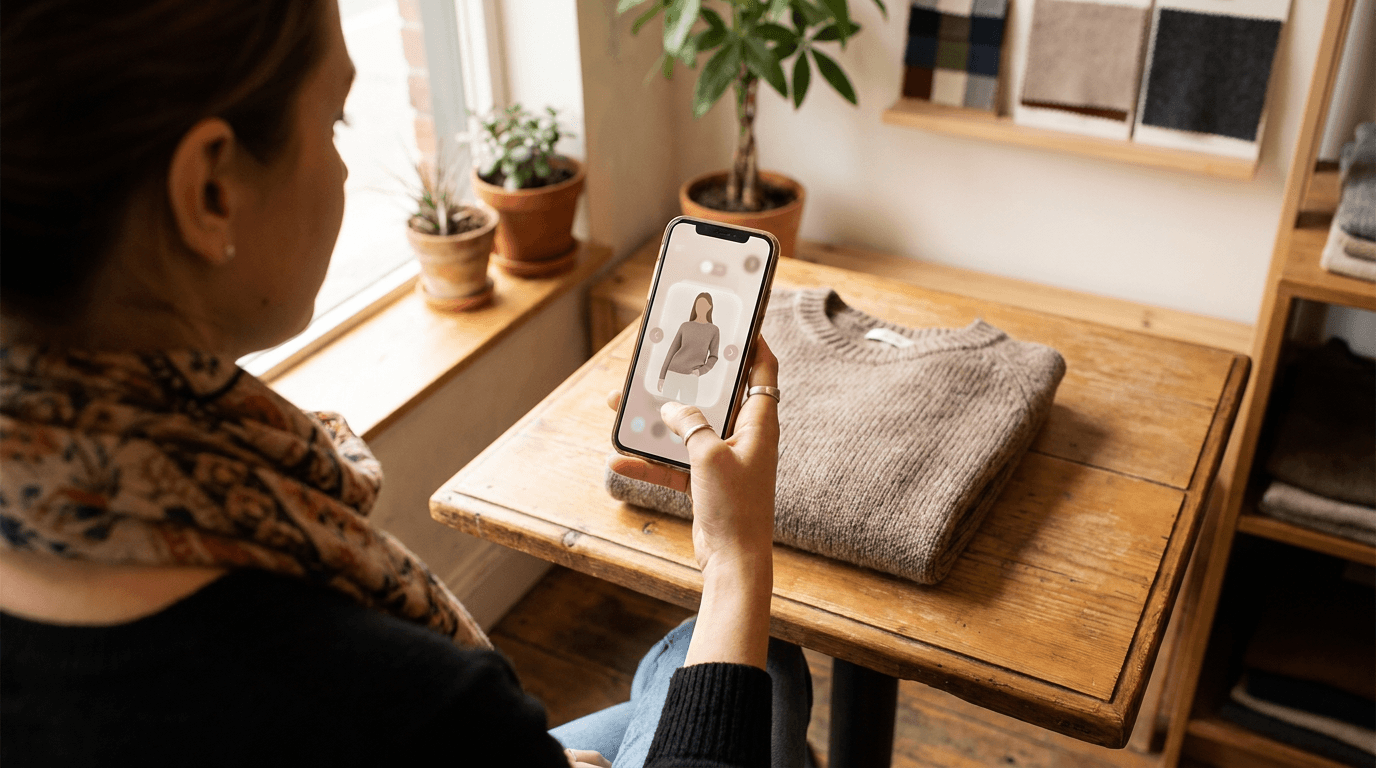
It helps most on pieces where the cut matters: dresses, tailored jackets, trousers, and anything with an unusual shape. A shopper who sees the piece on her own photo can judge the length, the shoulder and the colour against her skin before she pays.
It also helps with the Instagram problem. Many boutiques sell through social posts, and a shopper tapping through from a photo of a model has nothing to compare to herself. Seeing the garment on her own photo closes that gap. See how virtual try-on works for what the shopper actually does.
Single pieces benefit too. If you only have one dress in a size, a wrong guess means a return and a lost sale of the one item you had.
Picture a shopper eyeing a wrap dress in your size 12, unsure whether the waist will sit where she hopes. Without a preview she orders a 10 and a 12 and returns one, which is the exact parcel you were trying to avoid. With one, she picks once.
When should a boutique skip it?
Skip it for now if your return rate is already low, or if your customers are mostly local and try things on in the shop. Corlen has no free plan or free trial, so a subscription on a low-return store is a cost with little to offset it.
Also skip products with poor photos until you reshoot them. A crowded, cropped or heavily filtered image gives a weaker result, and a bad render is worse than none.
How can a boutique test it cheaply?
- Read your last three months of returns and count how many cite size or fit.
- Pick your ten best sellers with the most size returns, not the whole catalog.
- Run each one through the live demo with a few photos of yourself, and drop any piece that renders badly.
- Add the try-on block to those product pages in the theme editor using the Corlen Shopify app. It needs an Online Store 2.0 theme and plans start at $19.99 a month.
- Compare size returns on those products against the same weeks before, using the steps in how to measure virtual try-on results.
If your shop has real foot traffic, a tablet can run the same try-on in the store, and the in-store kiosk deletes photos after two hours. On Shopify, shopper photos are processed to build the preview and are not saved. When you are ready, try Corlen on your own photo and see what your customers would see.
Frequently asked questions
Is virtual try-on worth it for a small boutique?
It can be, if size and fit are your main reason for returns and your catalog has a few dozen pieces or more. With a very small, local customer base, count your return reasons first. If size is rarely the issue, the subscription may not earn its keep yet.
Does virtual try-on work for one-of-a-kind or limited stock pieces?
Yes. The app needs a clear photo of the garment and the shopper's own photo, so it does not matter how many units you hold. It is useful for single pieces, because shoppers cannot return to the same size later if it sold out.
Do I need a professional photographer?
No, but photo quality matters. A whole garment on a plain background or a mannequin, in even light, renders best. A phone photo taken near a window is usually enough. Test each piece in the demo before you switch it on.
Can a boutique use try-on in the physical shop too?
Yes. Corlen also runs as an in-store kiosk on a tablet, where photos are deleted automatically after two hours. Most boutiques should start online and add a kiosk only if shop traffic justifies it.
Ready to add real try-on to your store?
Install Corlen on Shopify in minutes, or build it into your own platform with the developer API.
Similar posts
Virtual Try-On for Print-on-Demand Clothing Stores: Is It Worth It?
Print-on-demand shirts are made to order, so a wrong size return is a total loss. Here is where virtual try-on helps a POD store, and where it cannot.
Read articleGuidesVirtual Try-On for Dropshipping Clothing Stores: Does It Pay Off?
Dropshippers pay the most for a size return, since the item often ships back overseas. Here is where virtual try-on helps, where it does not, and how to start.
Read articleGuidesDoes Virtual Try-On Slow Down Your Shopify Store? How to Check
A try-on app adds a script to your product page. Here is what it can cost in speed, the limit Shopify sets for apps, and a simple before and after test.
Read articleSee it on your own photo
Corlen shows your customers how any garment looks on their own body, in seconds. Try it free, no account needed.
Try Corlen free